Artificial Grass and Drainage — How Much Is Enough?
Looking for help with this? See our artificial grass in Preston and garden drainage in Preston. Get a quote or WhatsApp us photos.
On a lot of Lancashire plots the worry is not whether the turf will look green in February. It is what sits underneath after a wet fortnight: a plastic carpet over clay, water with nowhere to go, and a lawn that smells once the rain stops. That fear is reasonable. We see it on new-build rectangles and on older gardens where a cheap roll was laid on the old soil.
Yes, artificial grass needs drainage. The turf only lets water through the backing. How much extra work you need depends on the clay, the levels, and whether that water already has a way out. A full land-drain grid under every square metre is not the default. A free-draining base with a fall to a proper edge often is.
This sits next to our guide on artificial grass in wet UK climates. That piece is the yes-or-no decision. This one is the build: how much drainage is enough so the lawn does not become a plastic bog.
Does artificial grass need drainage?
It does. Outdoor turf is made with punched holes or a permeable backing so rain can pass through the pile. That is not the same as the garden being able to take the water.
Think of the carpet as a sieve. The sieve does not invent a drain. If you drop it into a dish of clay, or trap it inside solid timber edging with no weep, the water that went through the holes simply sits in the base. That is the bog people are imagining — and it is an install problem, not a product problem.
On plots around Preston, Leyland and Penwortham the ground is often heavy clay. Clay does not swallow a winter downpour the way a sandy soil would. So the question is never “does the grass drain?” It is “where does the water go once it is under the grass?”
What the turf actually does — and what it does not
Good garden turf should clear a shower in minutes, not hours. After a hard burst you may still see a sheen on the fibres while rain is falling. That is normal. What should not happen is a puddle that is still there mid-afternoon on a dry day, or a soft, dark patch that never quite dries.
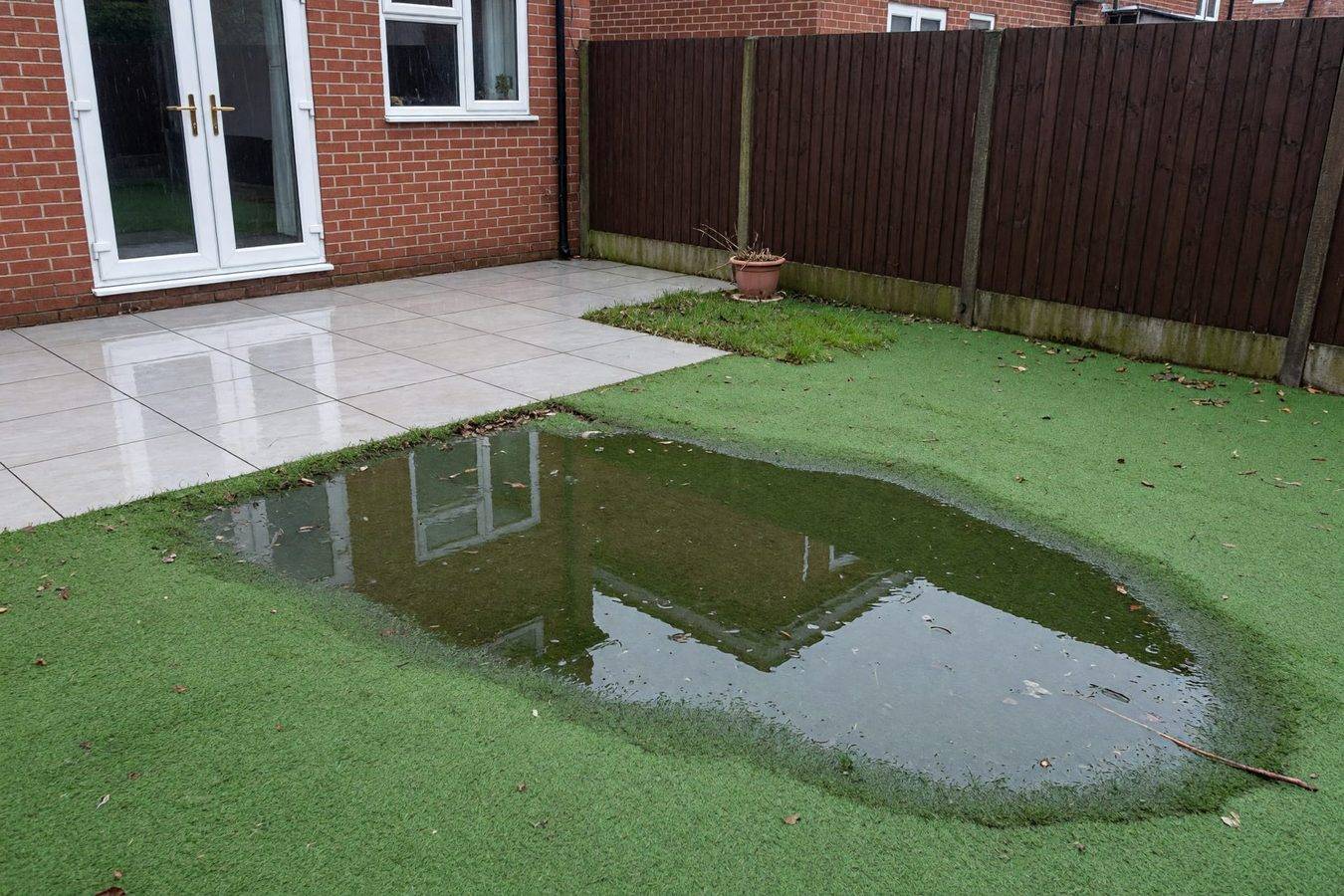
The turf will not:
- Fix a lawn that is already a bowl
- Deal with a downpipe that dumps onto the same rectangle
- Drain through a concrete slab with no falls or outlets
- Stay sweet-smelling if pet waste sits in a wet base
If the living lawn already ponds for a day after rain, rolling plastic over it will advertise the same water, not hide it. Drain or re-level first, then choose the surface. Our waterlogged lawn guide covers that ground-first work.
How much base is enough on Lancashire clay
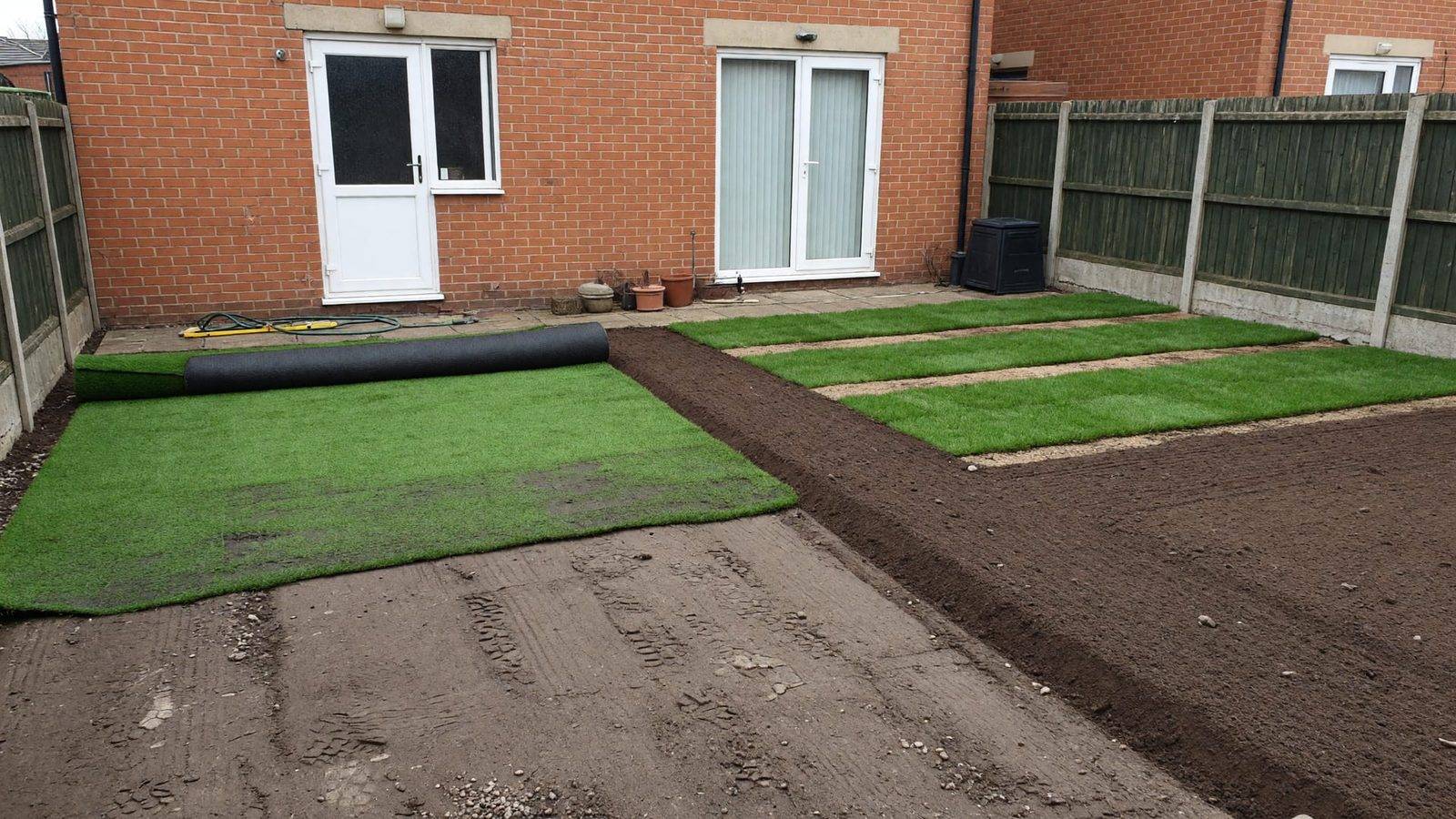
On a typical family lawn we excavate the old turf and organic soil — usually in the 75–100 mm range already described in our grass versus gravel comparison — then build a compacted, free-draining stone layer with a fall to an edge that can actually release water.
That stack is enough on many plots where water already wants to leave the garden. The details that decide whether it stays enough are simple:
- Stone that still drains after it is compacted. Fines-rich Type 1, hammered until it is almost concrete, can hold water on clay. On wetter plots we prefer a cleaner, more open stone so the base is a reservoir that empties, not a bath that fills.
- A fall you can feel, not a perfectly dead-flat “looking” lawn. A gentle run toward a border, patio channel or gravel strip is what keeps the sieve working.
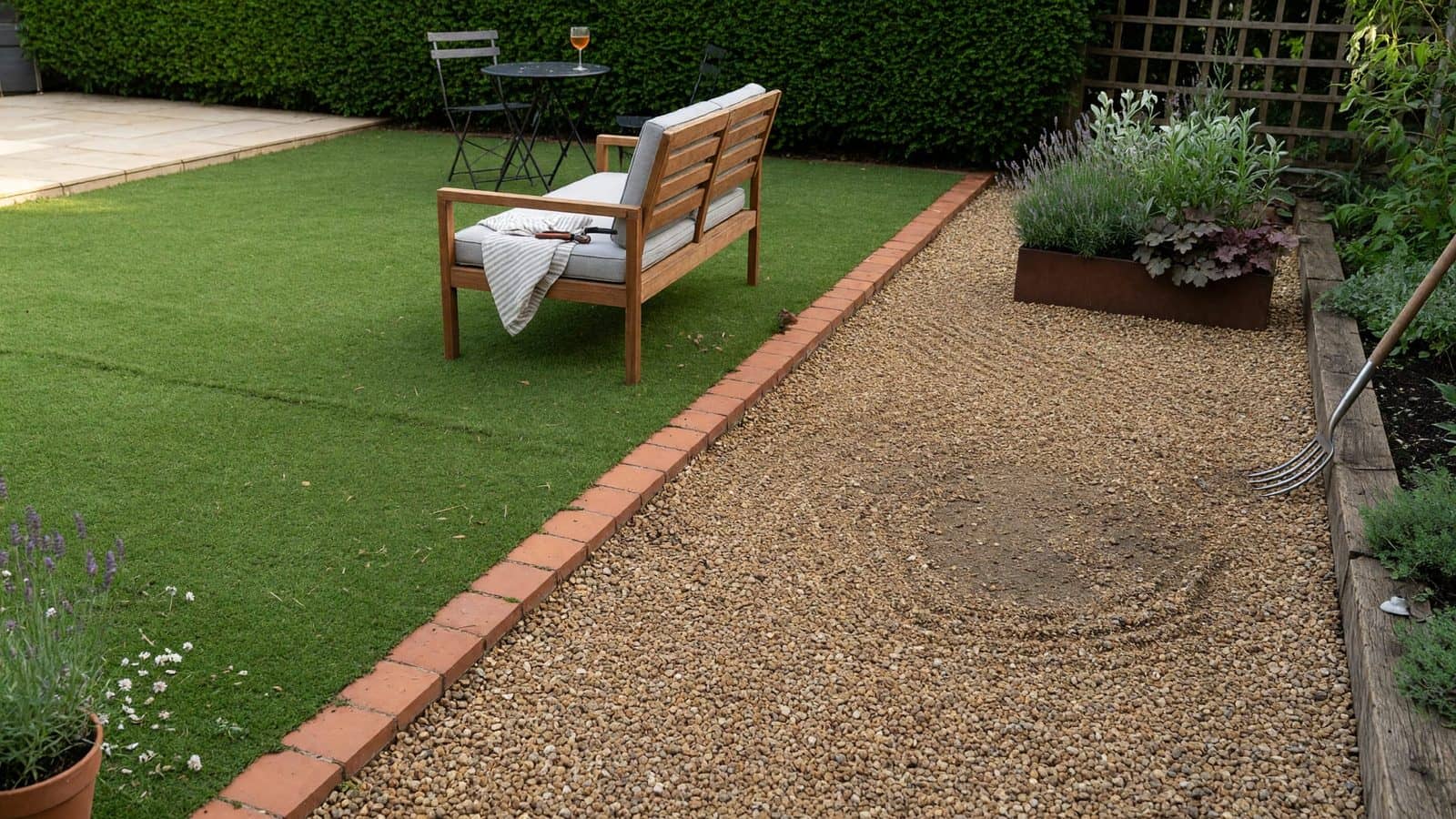
- An edge that weeps. Tight timber boxes with no gap, solid kerbs on all four sides, or turf butted hard against a raised patio lip will trap the water the backing just let through.
- Organic soil gone. Old topsoil and turf left under the carpet rot, shrink and hold moisture. That is how a new lawn develops dips in year two.
Membrane goes in as the system specifies. It is a weed and separation layer, not a waterproof liner. If someone has wrapped the whole excavation like a pond, that is the opposite of drainage.
When a stone base is enough — and when it is not
A well-built stone base is enough when the garden already sheds water, the new lawn is not the lowest point of the plot, and roof water is already caught. Most level rear gardens that are merely muddy rather than flooded sit in this group.
Add a land drain along the low edge when the lawn sits in a shallow dish, clay holds a perched water table after rain, or a patio and downpipe feed the same corner. A French drain — perforated pipe in clean stone, wrapped so silt stays out, running to a legal outfall or a soakaway that actually percolates — is usually the extra that turns “enough” into “reliable”. We use that pattern often on clay plots in Cottam, Broughton and similar new-build estates: not pipes under every metre of turf, a collector at the point water wants to sit.
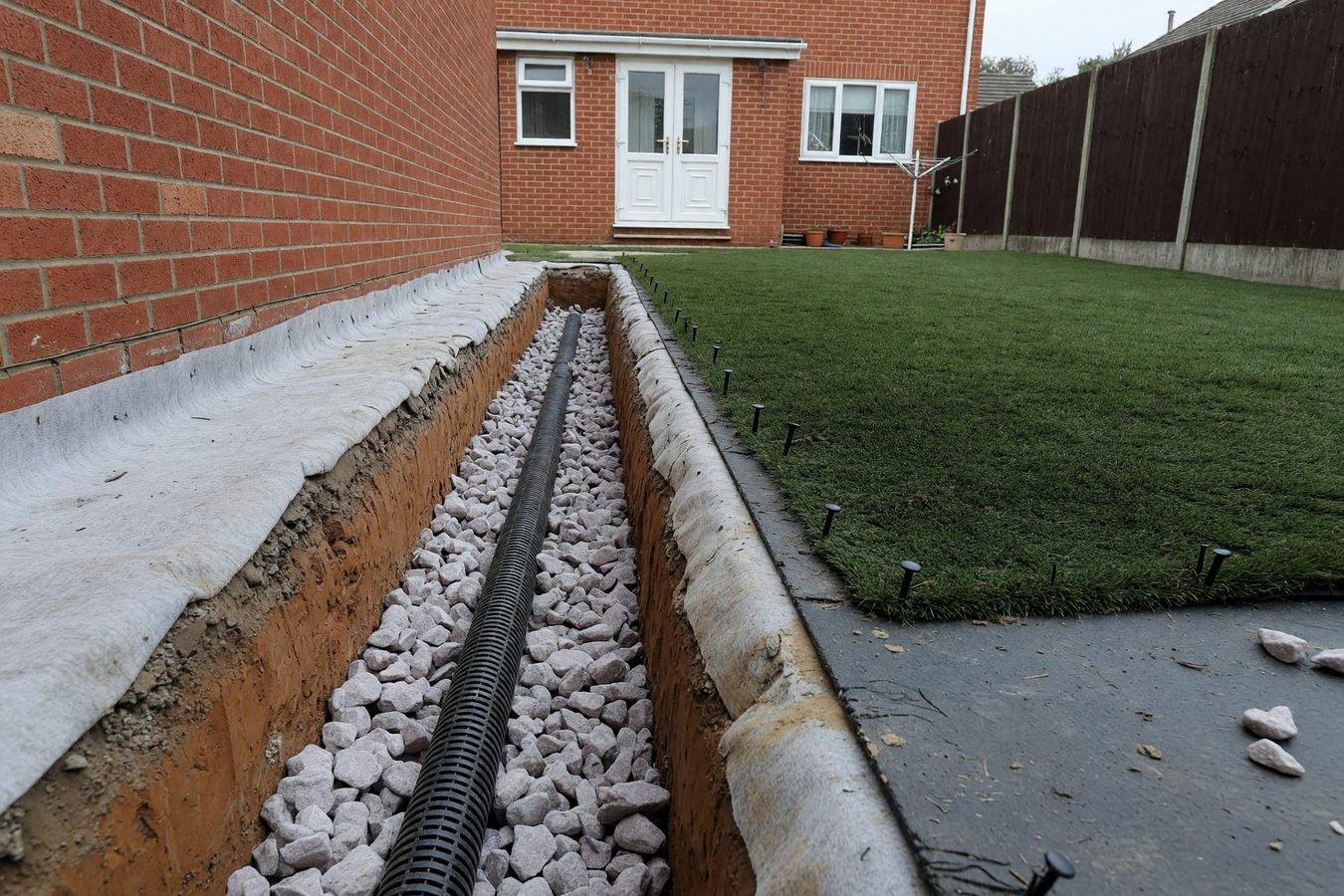
A fuller drain layout under the lawn is for the awkward minority: a true bowl, groundwater that sits high, or a plot that cannot fall to daylight. That is garden drainage work first, turf second. Laying carpet over a problem like that is how you build the plastic bog.
Soakaway crates only help if the ground will take the water. On tight clay, an undersized rubble hole is just a buried pond. We size and site those systems against how the plot actually behaves after rain, not against a catalogue drawing.
Water pooling after rain: normal lag versus a failed lawn
A useful on-site check is time, not panic in the first ten minutes.
While it is still raining hard, a dark sheen on the pile is ordinary. Half an hour after the rain has stopped, most of that water should have gone through. If the same patch is still standing two hours later on a dry afternoon, something in the path is blocked or missing — flattened fibres and dirty infill, a dip in the base, a sealed edge, or clay that never lets the stone empty.
If water is still there the next morning, the lawn is not draining. Brushing the pile can clear silted holes on an otherwise sound job. It will not lift a base that has settled into a puddle. That needs the turf peeled, the low spot rebuilt in open stone, and the fall put back.
The plastic-bog problem: sealed edges and the bathtub
The picture people fear is accurate on a bad install. You cut a tray into clay, fill it with stone, wrap it, drop turf in, and board the sides up tight. Every shower fills the tray. The carpet looks fine until you step on it and the ground feels cold and soft, or you catch a sour smell in still weather.
Two details create that bathtub more than the turf itself:
1. No outlet. Water through the backing has to leave sideways to a border, channel or pipe. If every edge is a dam, the only way out is evaporation. 2. Water arriving from elsewhere. A patio that falls the wrong way, a leaking joint at the kitchen doors, or a downpipe that still spills onto the lawn will overwhelm a base that would have been fine on its own.
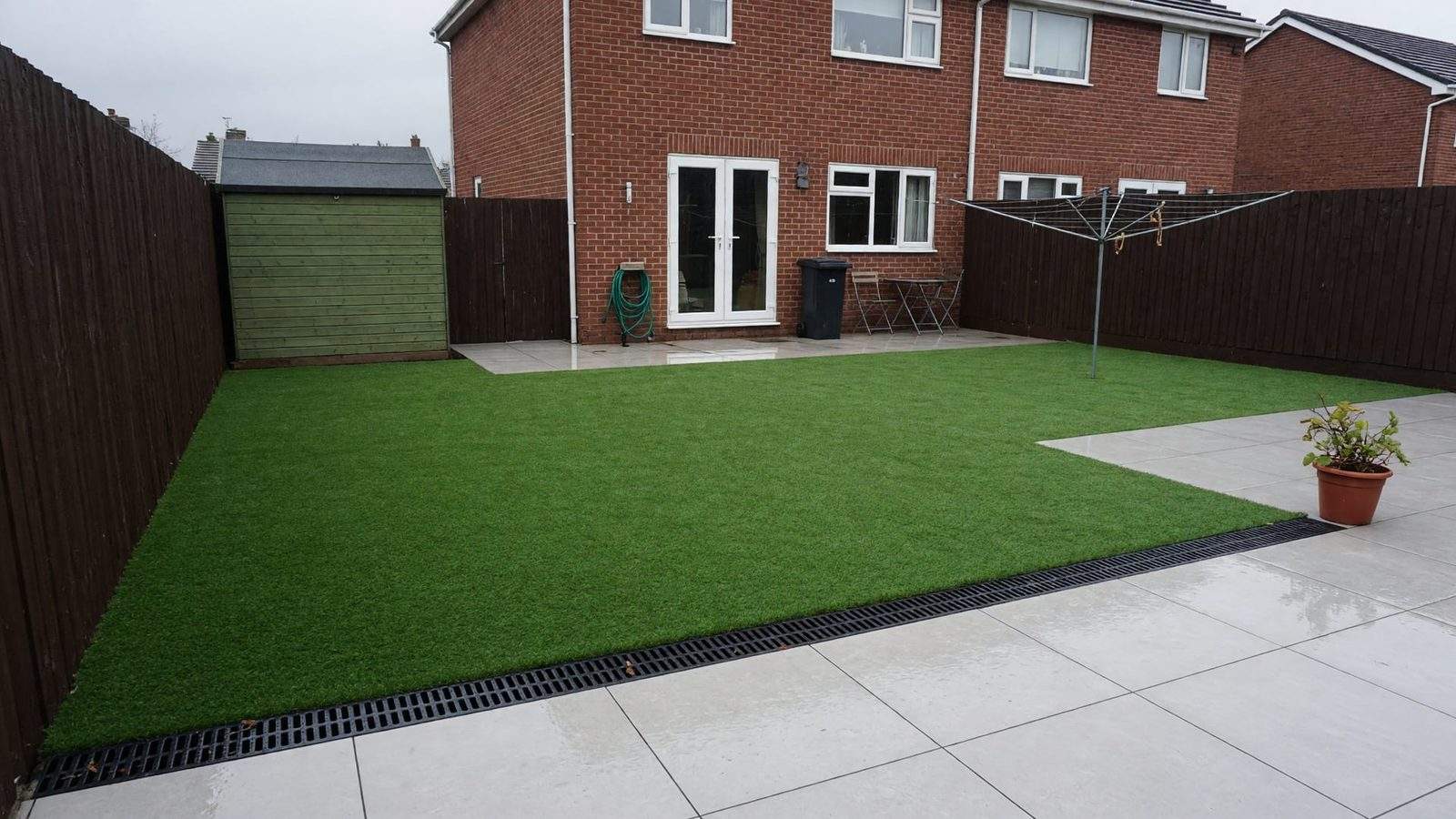
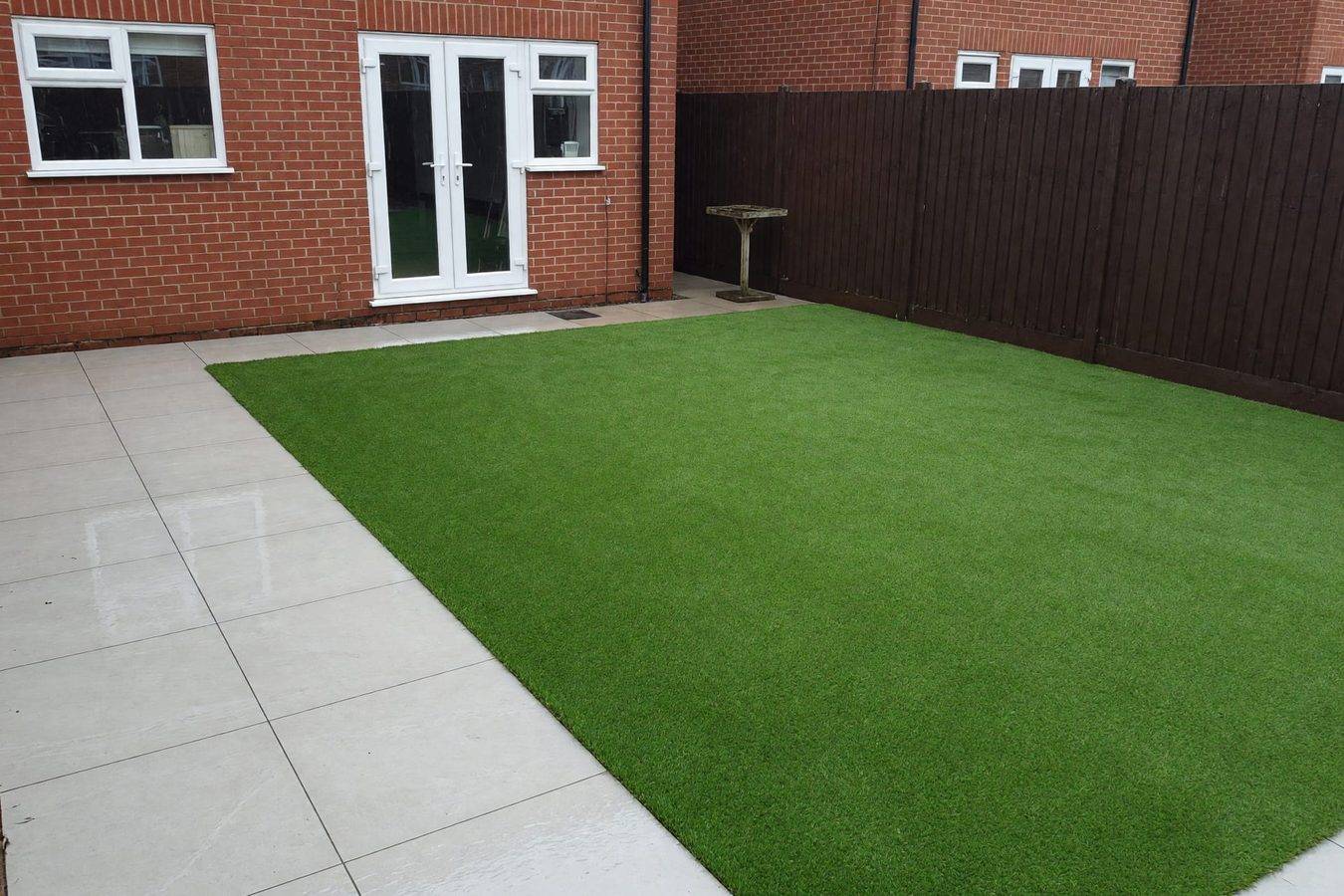
This is why we look at the whole rear garden — paving falls, thresholds and roof water — when someone only asked for a new lawn. The turf job and the drain job are often the same visit. A Tarleton-style layout with porcelain, a French drain and the grass sitting on the high side of that drain is the pattern that stays usable.
Pets, smell and standing water
Odour after rain is usually water plus waste sitting in a damp base, not the fibres going off. Rinsing helps on a lawn that already drains. If the same corner smells every time it rains, treat it as a drainage fault until proved otherwise.
Pet-friendly products and a rinse after a mess are still worth having. They are not a substitute for an outlet.
Laying turf over concrete or an old patio
It can work, but only if the hard surface already falls to a drain or an open edge. Water that goes through the backing and then sits on dead-flat concrete is the indoor version of the bog — just with a slab instead of clay.
If the old patio is dished or sealed against walls on three sides, lift it or cut in a channel before the turf goes down. Drainage cells under the carpet are a tool for that hard-surface case. They are not a reason to skip falls.
What we check before we price the lawn
A site visit for artificial grass in this climate is mostly a water conversation:
- Where does water sit two hours after rain?
- Does the plot fall toward the house, the fence, or a usable edge?
- Is roof water already caught, or still landing on the future lawn?
- Will a stone base and a weeping edge be enough, or does the low side need a pipe?
Photos of the wet patch after rain, plus whether the ground slopes toward or away from the house, are enough for a first online estimate. We measure levels on site before the figure is fixed. A 25% deposit books the slot; the specification you approve is what we build.
If the honest answer is “drain the garden, then decide on turf,” we will say that. Plastic over a pond is not a lawn.
Common questions
Does artificial grass need drainage holes?
Outdoor turf should. Flip a sample and look for an even pattern of holes or a fully permeable backing. Display matting with a sealed back is not a garden product.
Will water pool on artificial grass?
It can sit briefly in a downpour. It should not remain as a puddle once the rain has stopped. Persistent pooling is almost always the base, the falls or a blocked edge — not the brand printed on the roll.
Do I need a French drain under the whole lawn?
Usually no. A collector along the low edge, plus a base that can empty, covers most clay gardens we see. A pipe grid under the full area is for plots that cannot shed water any other way.
Can I lay artificial grass on soil to save the base?
Not if you want it to last a Lancashire winter. Organic soil moves, holds water and grows the dips that become puddles. The base is the drain.
Does a wet new-build lawn automatically need pipes as well as turf?
Not automatically. Some new-build rectangles are compacted and dished; some just need levels and a proper base. We treat that as its own question in does a new-build garden need drainage.
If you want a lawn that stays usable after Preston rain, start with where the water will go — then choose the turf. Send photos and the address for a free online estimate, or message us on WhatsApp on 01772 213019.
Enjoyed this guide?