Does a New-Build Garden Need Drainage?
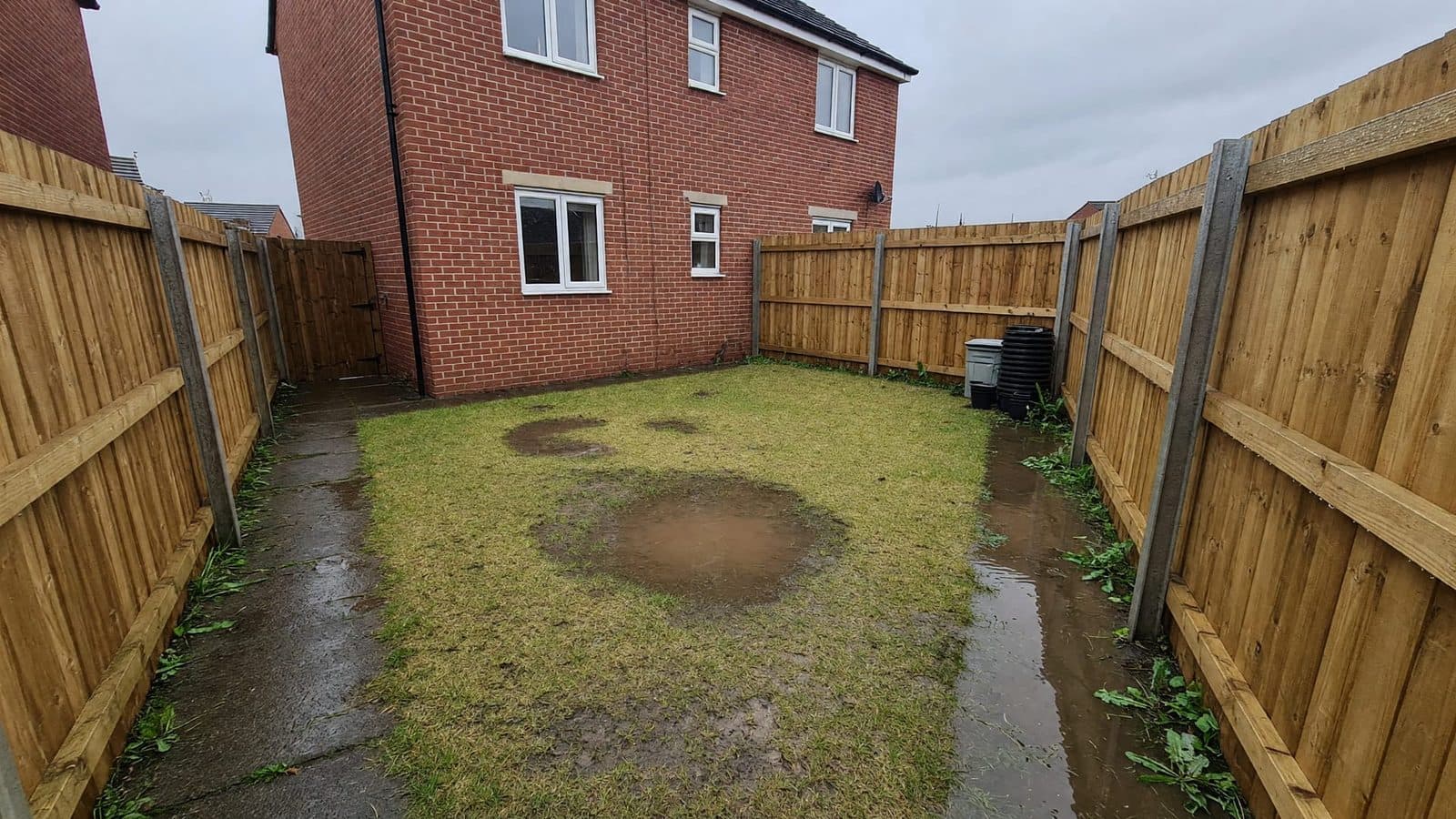
You moved in last autumn. The turf looked fine in the photos. Then November arrived, the lawn stayed dark and squashy, and by February you were stepping round puddles to get the bins in. On a Lancashire new-build that pattern is so common people treat it as part of the handover.
It is not always a drain job. It is also not always “just clay, give it a year.” The useful question is whether water has somewhere to go once it hits the compacted layer under that thin topsoil.
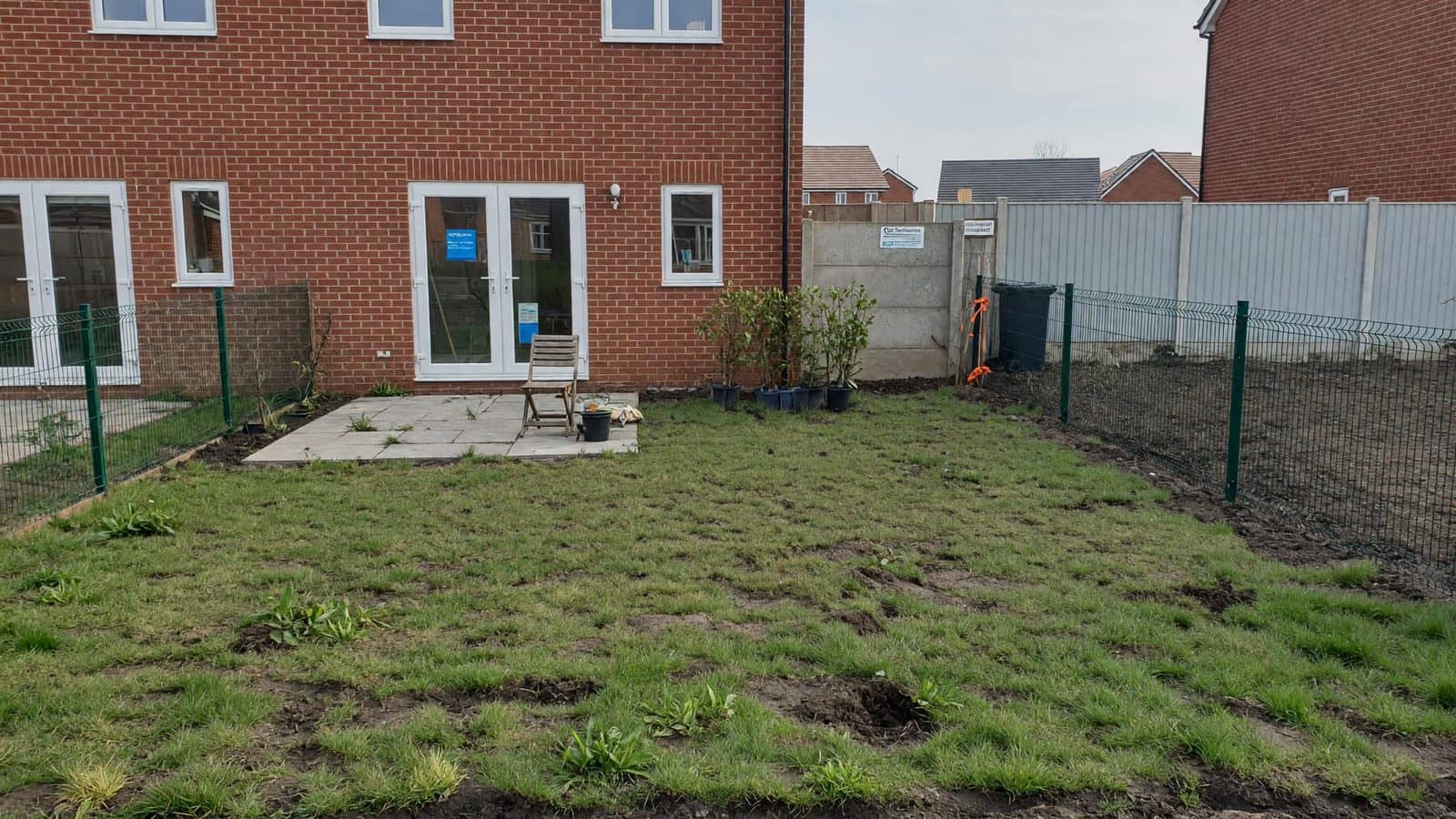
Most new-build lawns around Preston, Leyland, Cottam and Broughton sit on glacial clay that was driven over for months while the houses went up. The developer levels the plot, drops a shallow layer of topsoil and rolls turf on. Water hits that sealed pan and sits. That is the starting point, not a diagnosis on its own.
When you can wait a season
A new lawn on clay will look worse in its first winter than it will in year three, even if you never install a pipe.
Give it time if all of this is true:
- Puddles form after heavy rain and are gone within a day or two in milder weather.
- The wet patch is the middle of the lawn, not a strip against the house, a fence or a patio edge.
- The ground still has a slight fall away from the walls.
- Turf is thinning but not rotting in sheets, and you can still walk it in summer without leaving holes.
Spiking, a sand dressing and keeping off it in the wet months can help that first-year surface. They will not open a clay pan. Treat them as a test, not a cure.
When the lawn is telling you it needs a drain
Book a proper look if any of these hold after a second wet spell, not just one storm:
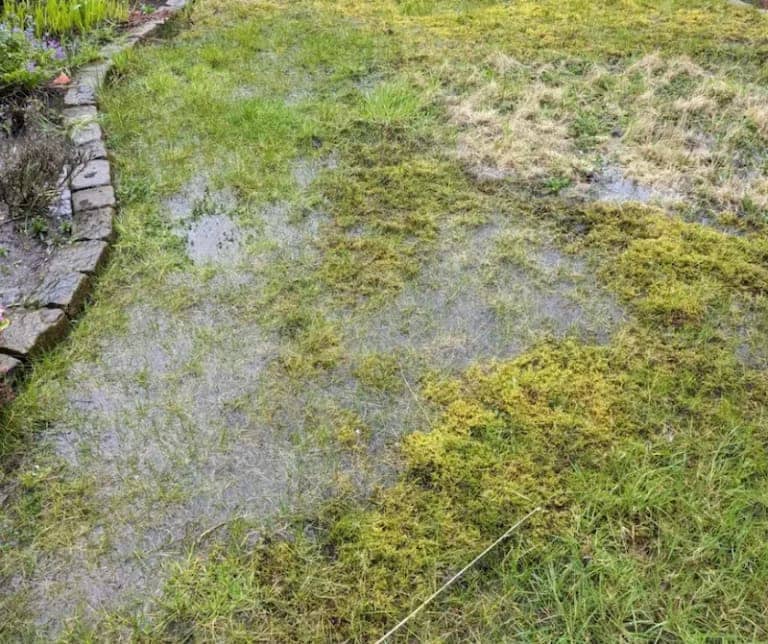
- Water sits for days, not hours, in the same footprint every time it rains.
- The soggy zone is against the house, under a downpipe splash, along a fence, or at the foot of a slope from a neighbour.
- The lawn smells sour, moss takes over, or grass lifts in mats because the roots never got air.
- You can see the ground falling *towards* the building or a patio that already ponds.
- A simple hole test (30–60 cm, filled with water, covered) still holds water hours later.
That last one is the RHS-style check we still use on site. If the hole does not empty, the soil is not going to “open up” because you wait another winter.
On plots we see in Cottam and Broughton the trigger is often not the whole garden. It is one low corner, a dish left by the roller, or runoff from the drive that the builder never intercepted. A short French drain or a channel at the patio edge can be enough. A rubble hole in the same clay is just an underground pond.
Clay, compaction and “the builder said it would settle”
Three things get mixed up.
Clay drains slowly. That is the soil. You live with it or you give water a path.
Compaction is the construction traffic. It turns that clay into a plug. Waiting does not un-compact a pan.
Levels are the shape. If the plot was flattened into a bathtub, gravity has nowhere useful to send the water. Re-grading sometimes does more than a pipe.
NHBC-type wording about gardens near the house not staying waterlogged in “normal” weather is a low bar, and “normal” in Lancashire is a lot of rain. The rest of the plot is often finished to look tidy on handover day, not to take kids, a trampoline and a wet winter. Warranty conversations and drainage design are separate jobs. If water is against the walls, deal with the ground first and keep a record; do not assume a claim replaces a fall or a land drain.
What we actually install when a drain is the answer
If the lawn needs help, the usual kit on these estates is straightforward:
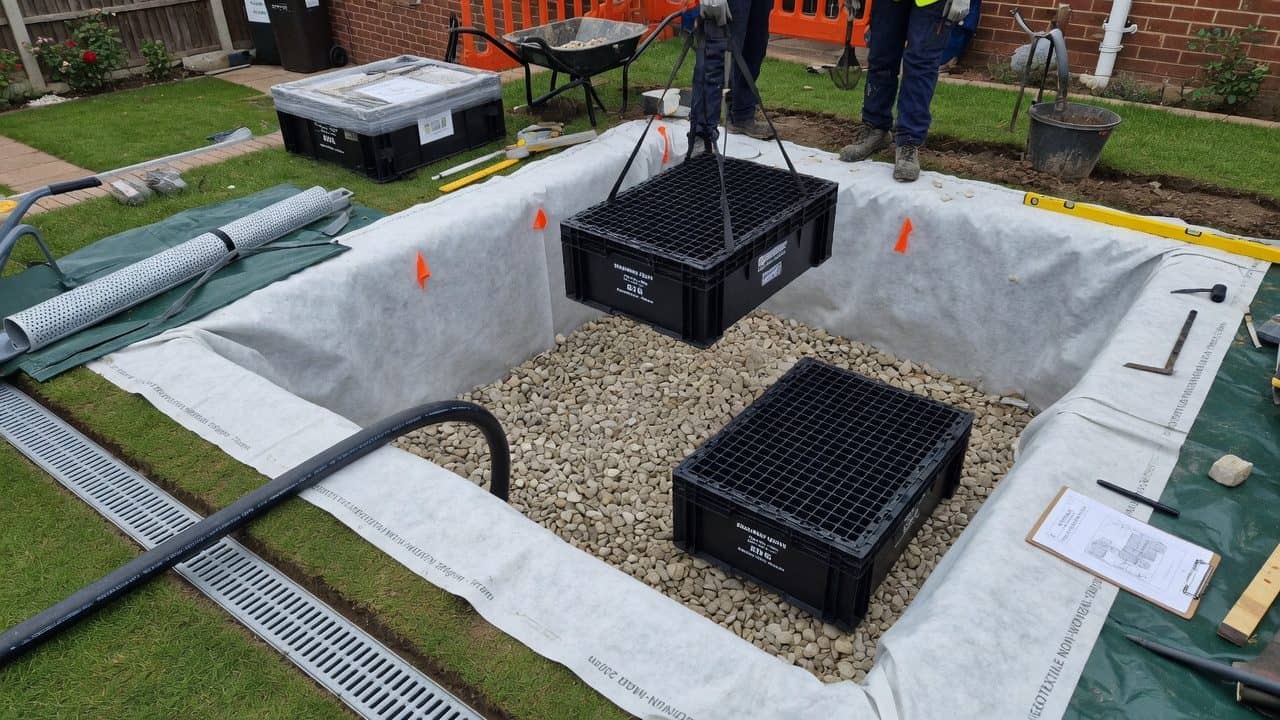
- A French drain (perforated pipe in clean stone, wrapped so clay does not silt it) along the wet edge or across the low line, taken to a legal outfall.
- A soakaway crate only where a percolation test says the ground will take water, kept the regulation distances from the house and boundary. On tight clay that crate often works as attenuation — it holds the storm and lets it go slowly — not as a disappearing act.
- Channel drains where a patio or path dumps water onto the turf.
- A pump chamber only when the garden is lower than the only legal discharge point. Gravity cannot run uphill.
We cover the how-to for crates in more detail in our drainage cube soakaway guide. The wider list of lawn options is in waterlogged lawn drainage. The longer new-build picture — compaction, thin soil, slopes — is in fixing new-build garden problems.
What we do not do is spike a sealed pan and call it finished, or bury a pipe with nowhere legal to empty.
A practical next step
After the next proper rain, take two photos: one of the wet area, one that shows whether the ground falls toward or away from the house. Note how long the water sat. That is enough for a free online estimate. WhatsApp 01772 213019 works if it is easier to send the pictures from the garden.
If it is first-winter clay and the levels are honest, we will say so. If it needs a drain, we will say that too, and design it as part of a usable lawn or patio rather than a trench that solves nothing.
Related services
Prefer a professional install in Preston & the North West? Explore the services that match this guide.
Enjoyed this guide?