Safer garden surfaces for older relatives
A lot of the gardens we are asked to look at were laid fifteen or twenty years ago: a few flags off the back door, a run of loose gravel, and a couple of stepping stones across what used to be a lawn. It looked tidy when it was new. On Lancashire clay, after years of rain, the membrane has sagged, the gravel has thinned into ruts, and the flags rock when you put a heel on the corner.
That is the garden adult children telephone about when Mum has started to use a stick, or when Dad will not go out after rain. The answer is not a catalogue of “elderly-friendly” products. It is to take out the surfaces that move underfoot, put a level, drained path where people actually walk, and rebuild the step at the door so it is one comfortable rise rather than a bulky platform.
Why these gardens become dangerous
Loose gravel is the surface we are asked to replace most often. A 20 mm decorative stone looks fine in a photograph. In use it rolls under a sole, collects in the tread of a walking frame, and gets kicked onto the paving where it behaves like ball bearings. Once the membrane below has failed — which it does, on wet clay — you get bare patches, weeds in the gaps, and a lip where the gravel used to meet the flags.
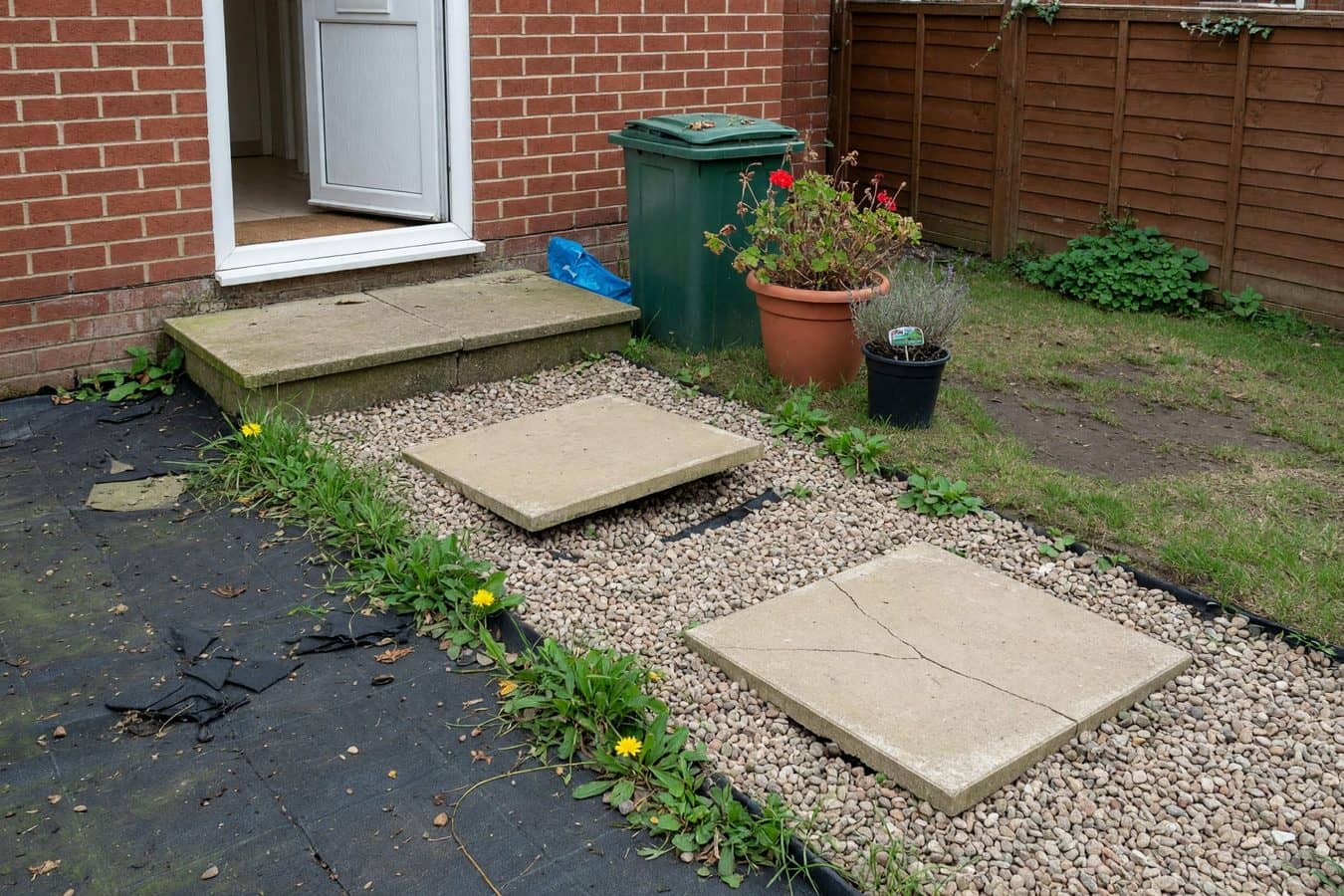
The paving itself is rarely much better by this point. Joints wash out, frost lifts a corner, and a 10 mm ridge is enough to catch a toe. RoSPA’s advice for gardens is simple and still the right starting point: keep paths, steps, patios and decking clear, level and in good repair. The repair, on most of these plots, means taking the mixed surface up rather than topping it up with another tonne of stone.
Falls in later life are common. Figures used by NICE put the chance of at least one fall a year at about 30 percent for people aged 65 and over, and about 50 percent for people aged 80 and over. RoSPA’s 2026 accident review found falls were the largest single group of fatal accidents in the UK, and where hospital admissions named a cause, same-level slips, trips and stumbles were the biggest specified group, with stairs and steps a smaller but clear share. Those numbers are not “garden statistics”. They are why a rocking slab by the back door is worth taking seriously.
This is landscaping advice, not medical advice. Strength, eyesight, footwear and medication all matter more than any surface we can lay. What we can do is stop the garden adding extra risk.
What to put down instead of loose gravel
For the route people use every day — door to bin, door to seating, gate to car — you want a surface that does not move and does not hold a puddle.
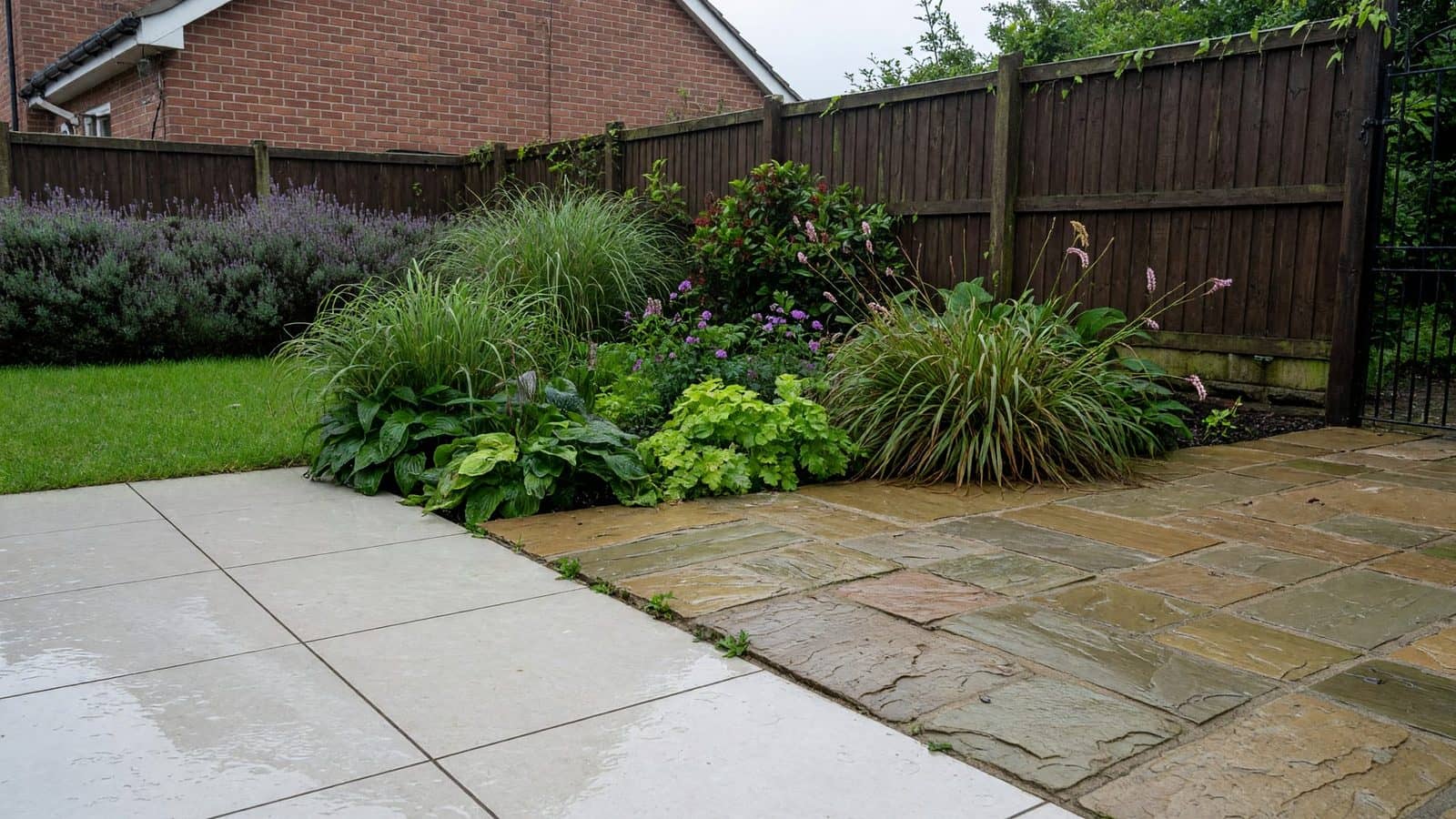
Paving is the usual choice for a sitting area. On Lancashire plots we lay porcelain or sandstone on a proper sub-base with a fall, so rain runs to a channel or a drained edge rather than sitting on the face. Outdoor porcelain in a textured grade is the lower-maintenance option in shade; riven sandstone has good grip when it is clean, but it will grow a green film on a north-facing path if you never wash it. Either material fails the same way if the ground underneath stays wet.
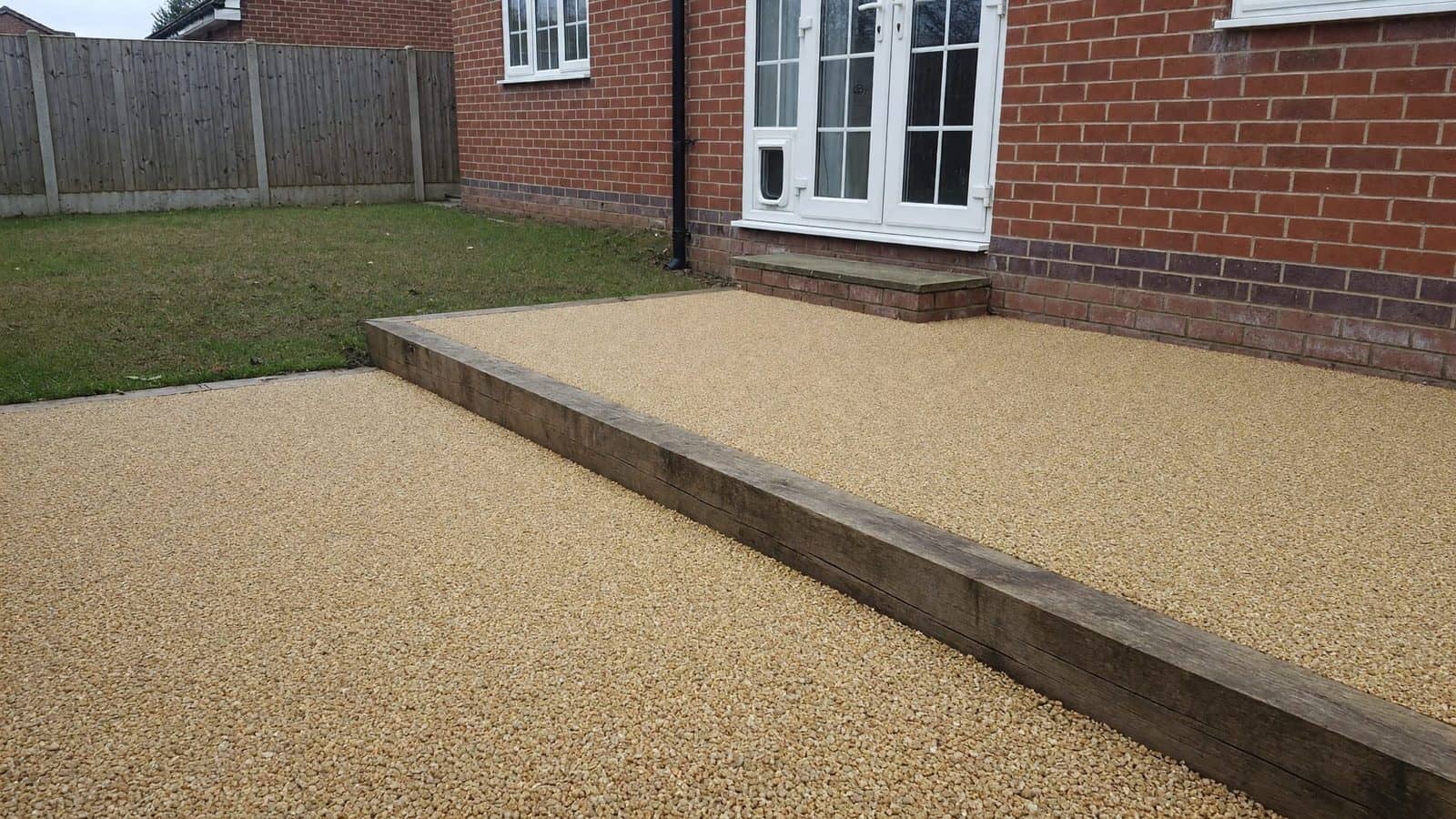
Resin bound gravel is the surface that most often replaces a tired gravel path or a front drive when the brief is “no loose stones, easy to sweep, alright with a frame or a wheelchair”. Bound resin is mixed so every stone is coated and locked; it is laid as one even sheet. That is not the same as resin *bonded*, which is glue painted on a base with stone scattered on top. Bonded sheds chippings. We do not use it. The difference is set out in our bound vs bonded guide.
Bound resin is permeable when it sits on an open, drained base, which is how it usually stays on the right side of the English 5 m² driveway rule. It is also only as safe as the specification. Angular stone grips better than smooth pebbles. An anti-slip grit can be added on a slope or a step tread. In deep shade the surface can still grow a biofilm, same as paving, and then it needs a wash — the maintenance notes are the same in a back garden as on a drive. A thin resin skim over rocking flags is not a repair. The flags have to come up.
Decorative gravel can stay in the borders, in a bound edge, where nobody has to walk on it. That keeps the look without putting rolling stone on the path.
A small lawn is still fine if someone wants somewhere for a dog or a grandchild. The hazard is the walk *across* the lawn on wet clay, not the grass itself. Put the hard path on the desire line and the lawn can sit beside it.
The bulky platform at the back door
After an extension, or on a 1970s semi where the garden has settled, the back door often lands on a single deep step or a timber platform that is too high and too short. You open the door and you are already on the nosing, with no place to stand while you turn. That is the step that gets people.
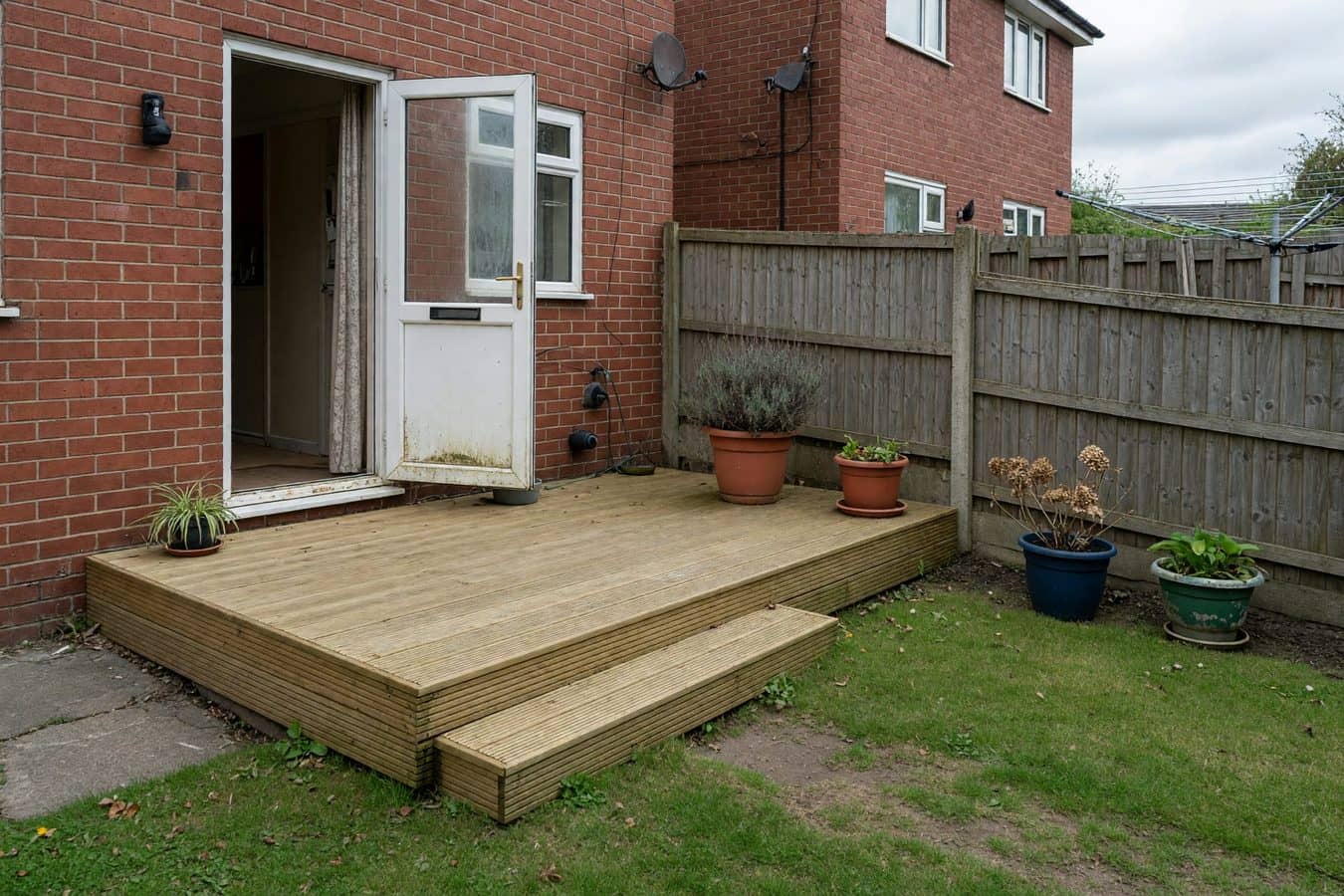
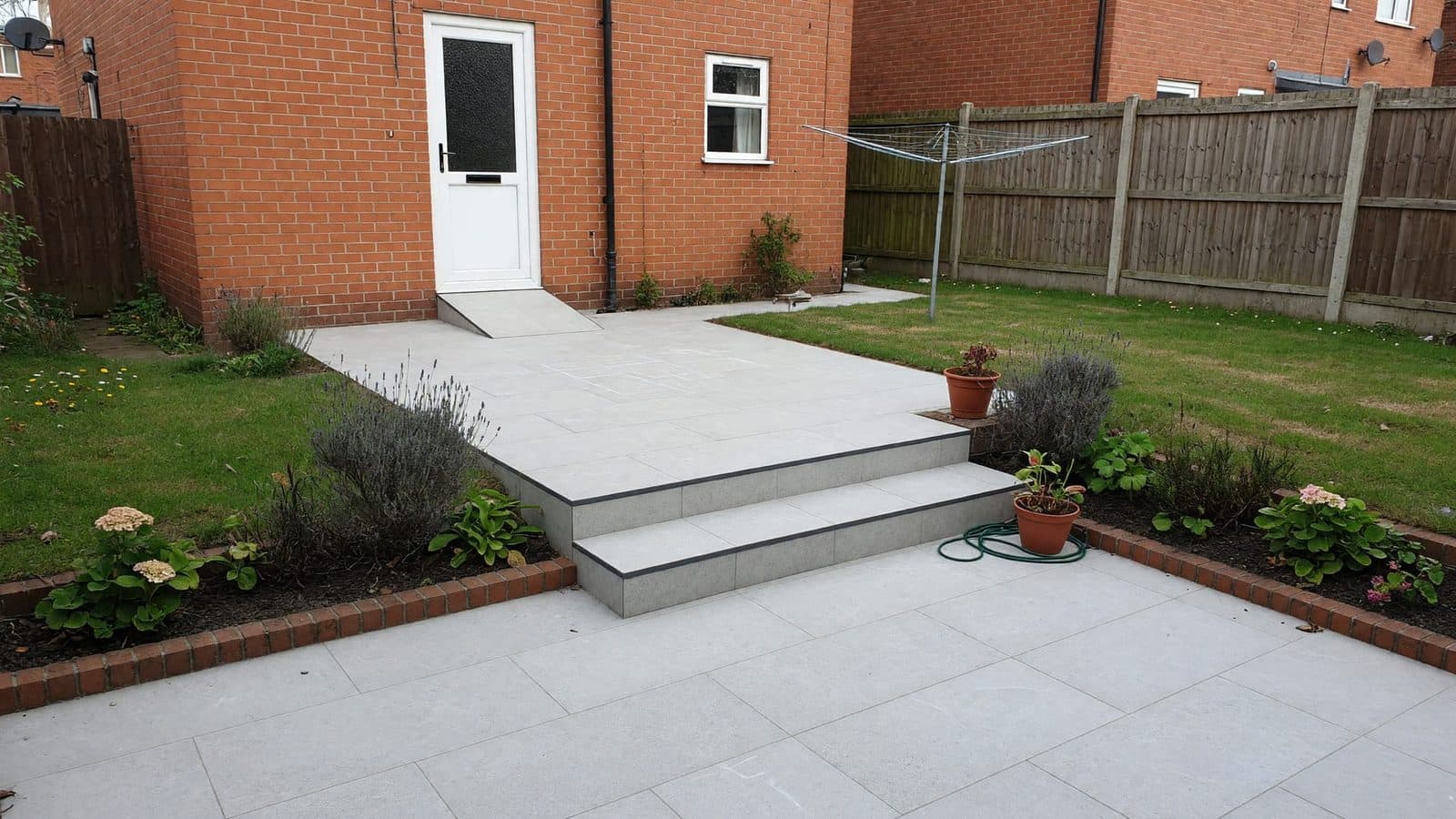
The better pattern is a level threshold — a small upstand, not a kerb — and a landing deep enough that the door can swing without putting you on the flight. From there, either the patio is brought up to door level with a fall away from the house, or the change in height is split into two or more shallow steps. A single tall riser looks neat on a drawing and feels nasty on a wet Tuesday.
If the drop is more than a couple of comfortable steps, a short ramp on the main route is often kinder than a long flight. We have built that mix — paving, a ramp, decorative stone kept off the walk — on ordinary Lancashire plots. The ramp needs a gentle gradient and a non-slip face; it is not a sheet of plywood on bricks.
Work around new doors is covered in more detail in Garden after an extension. The same level problem shows up on houses that have not been extended. The door is the datum. Everything else is cut to that.
Garden steps: rise, going, bullnose and square
Garden steps that only serve the patio are often outside Building Regulations. Steps that form the approach to the house are not. Either way, we set them out to the same numbers the approved documents use, because those numbers came from how people actually walk.
For a comfortable external flight we aim for a rise of about 150 mm — lower if we can get it — and a going of at least 280 mm. Approved Document M, where a dwelling needs a stepped approach, gives a rise of 75–150 mm and a minimum going of 280 mm, with a handrail once there are three or more risers and a landing at top and bottom. Approved Document K’s private-stair table is a little steeper (rise 150–220 mm, going 220–300 mm) and uses the old comfort check of twice the rise plus the going landing between 550 and 700 mm. We would rather be on the generous side of those figures than the tight side. Every riser in the flight should be the same height. An odd top step is a trip.
Square vs bullnose. A sharp, square nosing with a big overhang is the profile that catches a toe on the way down. Approved Document K asks you to avoid a protruding nosing where you can, and to keep any projection to 25 mm. A small bullnose or a chamfered edge is kinder to the foot and to a walking aid. A large decorative bullnose is not automatically better: it shortens the usable going and can make the edge harder to see. The useful combination is a modest rounded or chamfered nosing, a closed riser so a stick cannot slide under the tread, and a contrasting nosing strip — the approved documents talk about a 55 mm band on the tread and the riser — so the edge reads in low light and after rain.
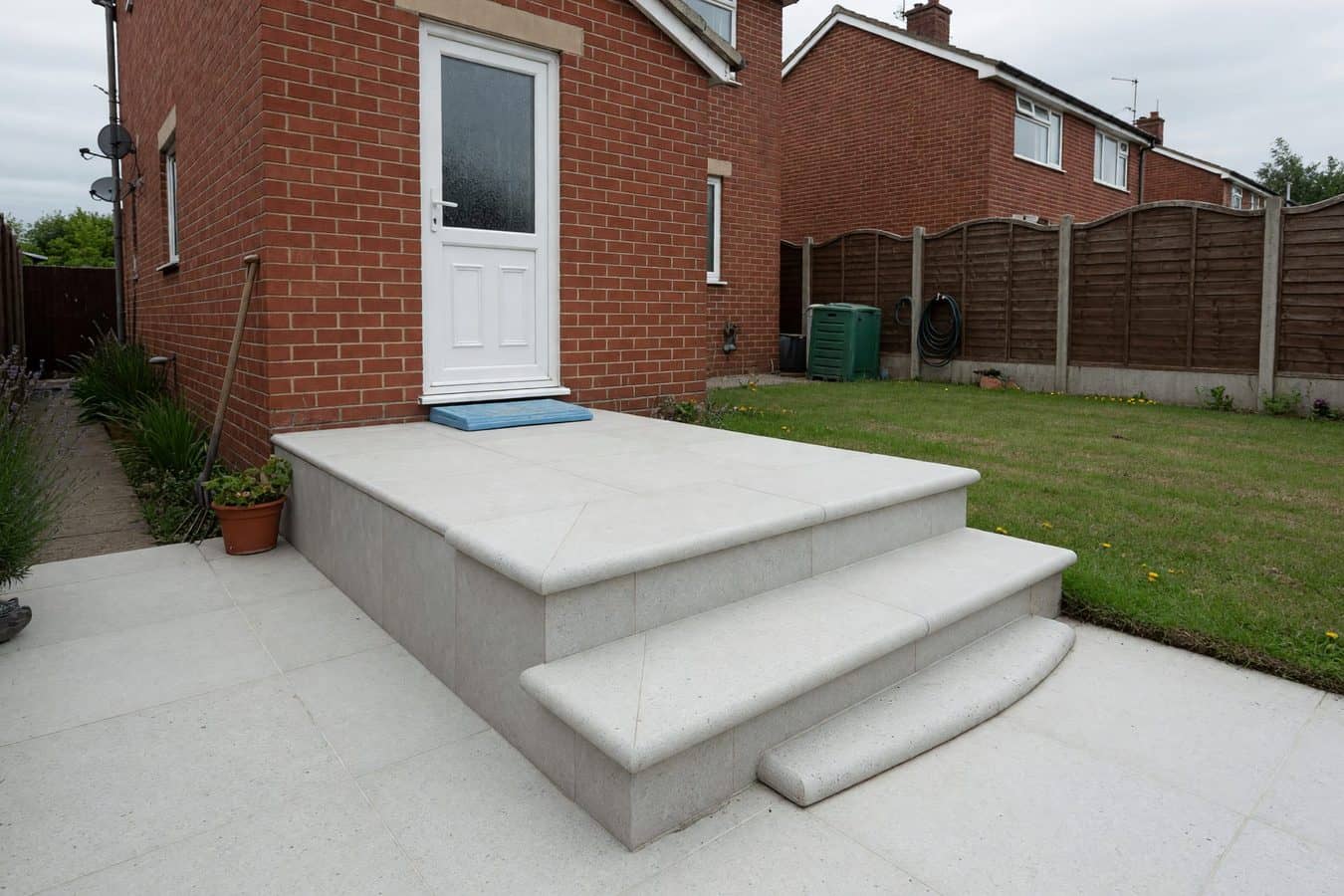
Treads need grip as well as shape. Honed porcelain on a step is a poor choice. Riven stone, a textured porcelain, or resin bound with an anti-slip additive on the tread all work if the fall sheds water. Open risers and single isolated steps are the two details we try not to leave in a garden that older relatives will use.
Handrails belong on any flight of three or more, and on shorter flights if the user wants one. Fix them into the structure, not into a wobbling planter.
What we leave alone
Not every gravel bed has to go. A bound-edged border with stone in it is low maintenance and safe if the walking surface is paved or resin. Not every patio has to become porcelain. If the existing flags are sound, level and well drained, lifting them “for safety” wastes money; cleaning the algae and re-jointing the open joints is the job.
Lighting and a clear route matter as much as the finish. A perfect resin path that dog-legs around a water butt in the dark still produces a fall. Keep bins, pots and hose reels off the walking line.
How we take this from a phone photo to a finished path
Send the address, a few photographs of the door step and the gravel, and a note about who uses the garden — a stick, a frame, a scooter, a dog. The free online estimate is the starting point; WhatsApp 01772 213019 is fine for the pictures. If the job is a fit we measure on site, set the door threshold as the datum, and write a fixed specification before anyone digs.
The work is the same family of paving, resin bound and drainage we already do on mid-sized Lancashire gardens. A 25 percent deposit books the slot; we are usually two to three months out, longer in peak season. Written guarantees follow the materials, as on the rest of the site.
If you only want someone to walk the plot and say what is actually a trip, start with photographs. We will tell you whether the gravel can stay in the borders or whether the whole path has to come up.
FAQ
Is resin bound safe for someone with a walking frame? A well-laid bound surface is level and does not shed stones, which is why we use it on paths where a frame or a wheelchair has to roll. It still needs a firm, drained base, enough width, and a wash if algae builds in the shade. Bonded resin is the wrong product for this job.
Do garden steps have to meet Building Regulations? Steps that are the official approach to the house are covered by the approved documents. A short flight that only serves a patio often is not. We still set rise, going, nosings and handrails to the same pattern so the flight is consistent and readable.
Can you just put resin over the old gravel? No. Gravel and a failed membrane are not a base. The loose stone comes out, the ground is rebuilt, and the resin goes on a specified, compacted, drained build-up.
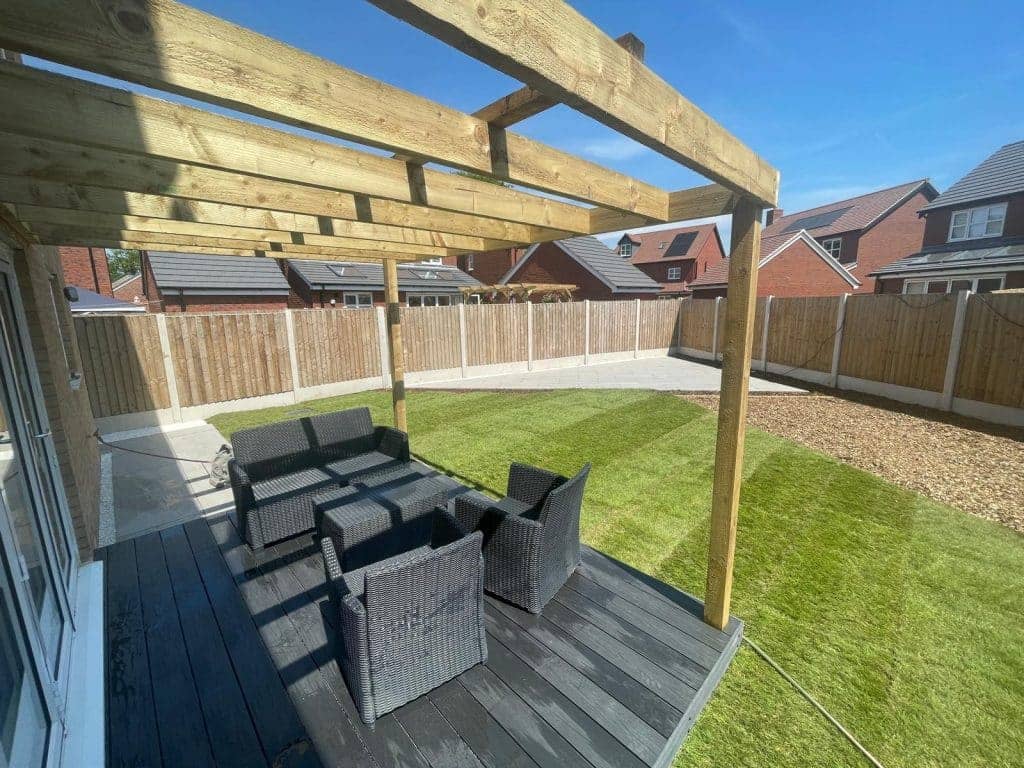
What about decking instead of a patio? Composite or timber decking can work as a sitting area, but in a wet, shaded Lancashire garden the boards grow a film and the frame has to be built properly. For a daily route from the back door we usually prefer paving or resin. If decking is already there, the steps off it need the same rise, going and grip as any other flight.
Related services
Prefer a professional install in Preston & the North West? Explore the services that match this guide.
Enjoyed this guide?