Porcelain vs Sandstone Patios in Lancashire Weather
Porcelain is the lower-maintenance slab for most modern Lancashire patios. Indian sandstone is the warmer, traditional one. In Preston rain and frost both last if the base drains and the patio falls away from the house. Both fail the same way if they sit in a wet tray of clay.
Key takeaways
- Porcelain is dense and almost non-porous, so it shrugs off stains and frost in the slab itself. Every drop of rain still has to leave via falls and channels.
- Indian sandstone is porous. It weathers warmly, grips well when riven and clean, and needs sealing plus more frequent washing in shade.
- On glacial till around Preston, the base fails first. A Type 1 bed boxed in by clay behaves like a bathtub and will lift either material.
- Choose porcelain for a modern, wipe-clean patio. Choose sandstone for a weathered look you will wash and seal.
Which material actually suits Lancashire weather?
Lancashire weather does not pick a winner on its own. Porcelain handles the wet and the frost better as a material. Sandstone handles the same weather if it is sealed, kept clean and laid on the same drained base.
For most of the mid-sized jobs we quote — new builds, extensions, light-grey sitting pads off bifolds — we specify porcelain. We specify sandstone when the house is older brick or stone and the client wants that weathered face.
Both last for decades on a compacted base with a fall away from the house. They fail in different ways when that work is skipped.
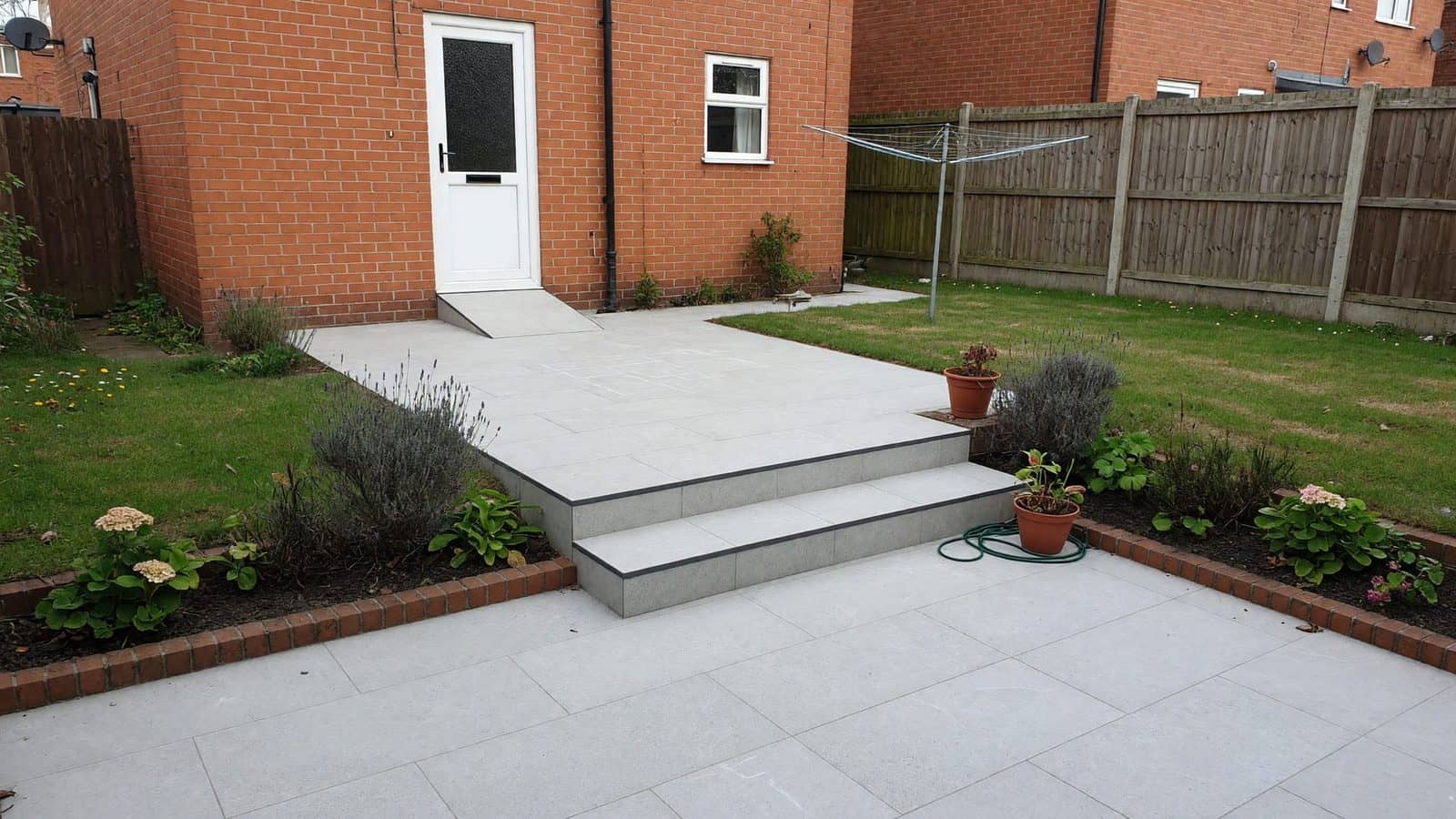
Porcelain is fired until the body is vitrified. Water absorption is typically under 0.5 percent, so the flag itself does not drink rain, barbecue fat or leaf tannin. Frost has little to freeze inside the tile. That is why it stays crisp on modern plots in Cottam, Buckshaw and new-build Fulwood.
Indian sandstone is a natural, open stone. Quality calibrated flags from a reputable quarry handle British winters well, which is why we still lay them on traditional houses in Lostock Hall, Blackburn and village plots that want warmth rather than a showroom plane. The same pores that give the stone character also hold moisture, so algae and lichen colonise shaded, north-facing corners unless the surface is sealed and washed.
Preston takes roughly a metre of rain a year and around forty air-frost nights. The weather is not exotic. It is simply wet enough, often enough, that a patio with no fall and no outlet will look dirty by the second winter — porcelain film or sandstone stain, same complaint.
How porcelain behaves in rain, frost and shade
Porcelain does not grow algae *in* the body of the tile. A thin green film can still sit *on* it where water ponds under a fence line, under a table or on a patio that falls the wrong way. That film rinses off. It does not etch the face the way organic growth etches sandstone.
Frost resistance comes from the same low absorption. If a porcelain patio cracks, the usual cause is mechanical: a point load, a hollow bed, or ground movement under a clay base — not ice inside the tile.
Slip depends on the finish, not the word “porcelain”. Exterior-grade tiles are textured; many carry an R11 rating, which is the usual minimum for open UK gardens. Polished indoor tiles do not belong outside. We only specify outdoor porcelain.
Cleaning is a brush, a hose and an occasional patio wash. Sealing is rarely needed. The work that actually keeps porcelain looking new is the jointing and the fall, which is why the compound on a porcelain patio is not the same product we use on sandstone.
How Indian sandstone behaves in the same weather
Riven Indian sandstone is naturally grippy when it is clean. The irregular face sheds water and gives bare feet and wet shoes something to hold. Once algae or moss sits in the texture, the same face becomes slick. North-facing yards, plots under trees and gardens that stay wet after rain need a yearly wash more than a porcelain patio does.
Sealing is not a fashion extra on porous stone in this climate. A breathable impregnator slows staining from leaves, fat and tannin and cuts how much water the face holds through freeze–thaw. It is not a substitute for falls. Water that sits in the joints and the bed will still work the pointing apart.
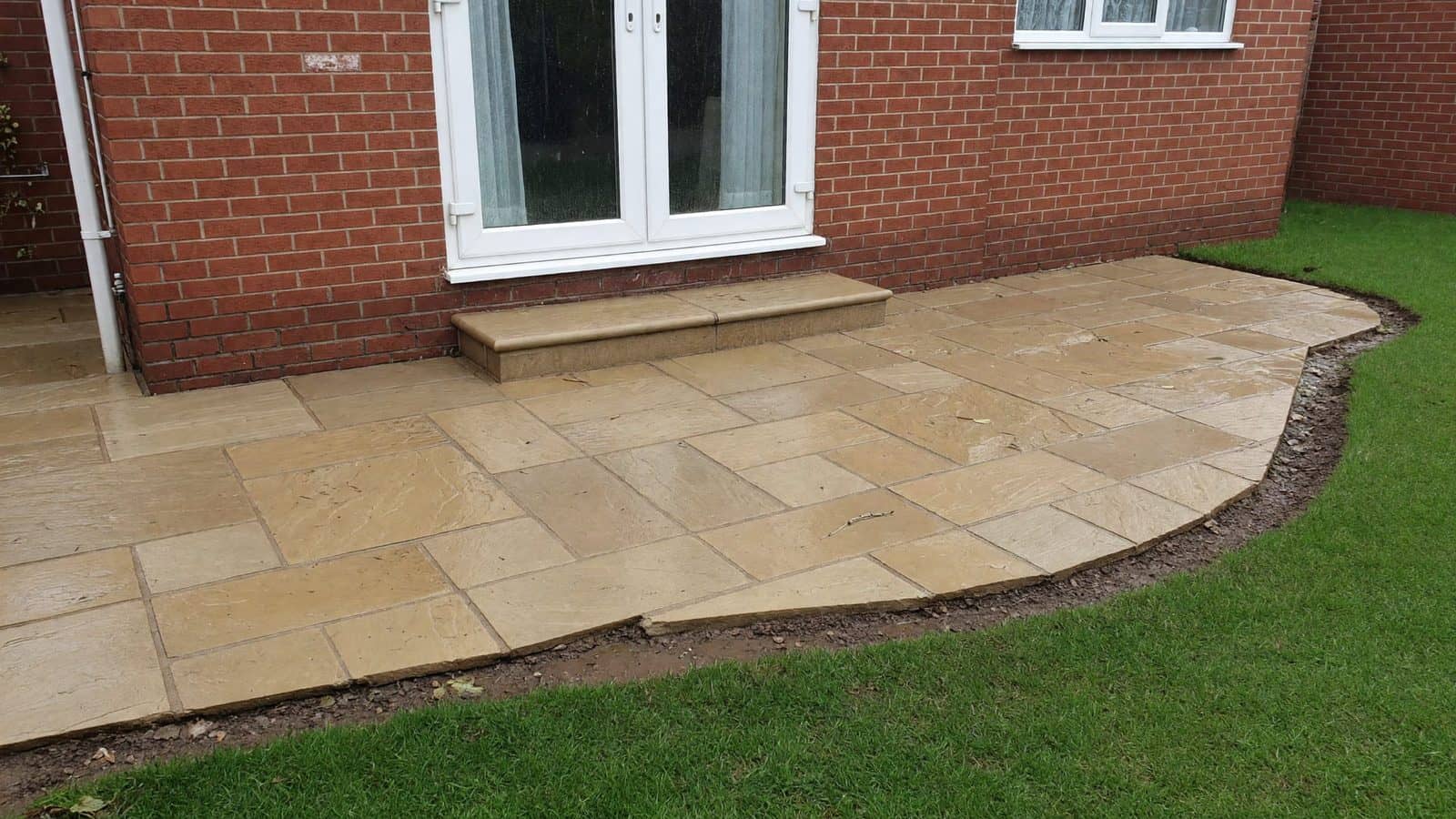
Colour movement is part of the deal. Raj Green, mint and autumn blends shift as they weather. That is the look people want next to Accrington brick and older stone houses. It is the wrong look if the brief is a flat light-grey plane that matches new bifolds.
Sandstone is easier to cut and bed with traditional mortar methods. That can matter on fiddly steps, radii and small yards where a lot of the slab will be cut on site.
What actually fails on Lancashire clay
The slab is rarely the first failure. The ground is.
North of the Ribble — Cottam, Broughton, Ingol, parts of Fulwood — sits on glacial till. The clay particles pack tight. Developer plant then smears that clay into a pan. Rain cannot soak away, so it sits.
A common cheap build is: dig a tray, fill it with MOT Type 1, bed flags, point, walk away. On clay that tray is a bathtub. The sub-base fills, the mortar stays wet, salts come through as white efflorescence, joints open, and the next hard frost heaves a flag. Porcelain and sandstone both rock once the bed is saturated. Porcelain just makes the standing water more obvious, because none of it disappears into the face.
What we change on those plots:
- Falls of about 1 in 60 to 1 in 80 away from doors and walls, checked from the finished floor level — the same discipline we use after an extension.
- An outlet. That may be a linear channel against the house, a French drain at the downhill edge, or a connection into an existing surface-water drain. A soakaway only works if it sits above the winter water table; on low ground near the Ribble it often does not.
- A base that can drain or is isolated on purpose, not a rubble sump with no exit.
- Jointing chosen for the slab. Tight porcelain joints need a porcelain system. Wider sandstone joints need a compound that will not stain the face.
Garden drainage is part of the patio, not a later extra. The same pattern shows up on new-build plots in Cottam and Broughton: turf over a clay pan, then a patio asked to fix a water problem the flags cannot solve on their own.
Matching builder flags and the colour people actually name
Light grey porcelain is the colour customers ask for most. On site that usually means a Kandla Grey or similar mid-to-light grey outdoor porcelain, which we have used on Preston and Penwortham rear gardens next to bifolds and composite decking.
Builder-installed flags are a separate problem. New-build and extension plots often arrive with a small patio already down — a leftover batch from the house-builder. If you want the new paved area to read as one surface, send a photo with the estimate. We can usually get close. An exact factory batch match months later is not something we can promise, because production runs change and the original flags have already weathered.
When the existing flags are the wrong level, the wrong fall or the wrong product (indoor porcelain outside, or a cheap concrete that is already scaling), it is cleaner to lift them and start again than to extend a failure. We say so at estimate stage rather than hide it in the price.
Porcelain vs sandstone at a glance
- Look — Flat, consistent, modern. Light grey is the usual request. — Varied, warm, weathers in. Suits brick and older stone.
- Water in the slab — Very low absorption. Stains sit on the face. — Porous. Drinks tannin, fat and rain unless sealed.
- Algae — Surface film where water ponds. Does not colonise the body. — Grows in the texture, especially in shade.
- Frost — Flag itself is frost-resistant. Failures come from the base. — Sound stone lasts. Saturated, unsealed faces can flake.
- Slip when wet — Good if it is textured outdoor grade (often R11). — Good when riven and clean. Poor once algae sits.
- Cleaning — Brush and wash. Sealing rarely needed. — Wash more often. Breathable sealer every few years.
- Cutting and bedding — Hard, needs the right blade, full bed and primer. — Easier traditional mortar bed.
- Best fit here — New builds, extensions, outdoor kitchens, low-maintenance yards. — Traditional houses, softer planting schemes, matching older stone.
Neither column is “the expensive one” in isolation. Groundworks, waste, drainage and access decide most of a Preston patio price. Material choice moves the supply and cutting band; it does not replace a proper base. The cost and programme factors sit in our patio and paving cost guide.
Which should you choose?
Choose porcelain when the house is modern, the doors are wide, you want a surface that wipes after a spill, and you would rather wash the patio twice a year than seal it. That is most of the mid-sized jobs we quote on new estates and post-extension plots.
Choose sandstone when the house is older brick or stone, you want movement in the colour, and you accept a yearly clean. It still needs the same falls and outlet as porcelain. The romantic version — flags dropped on sand in a wet Lancashire garden — is what we take up again three winters later.
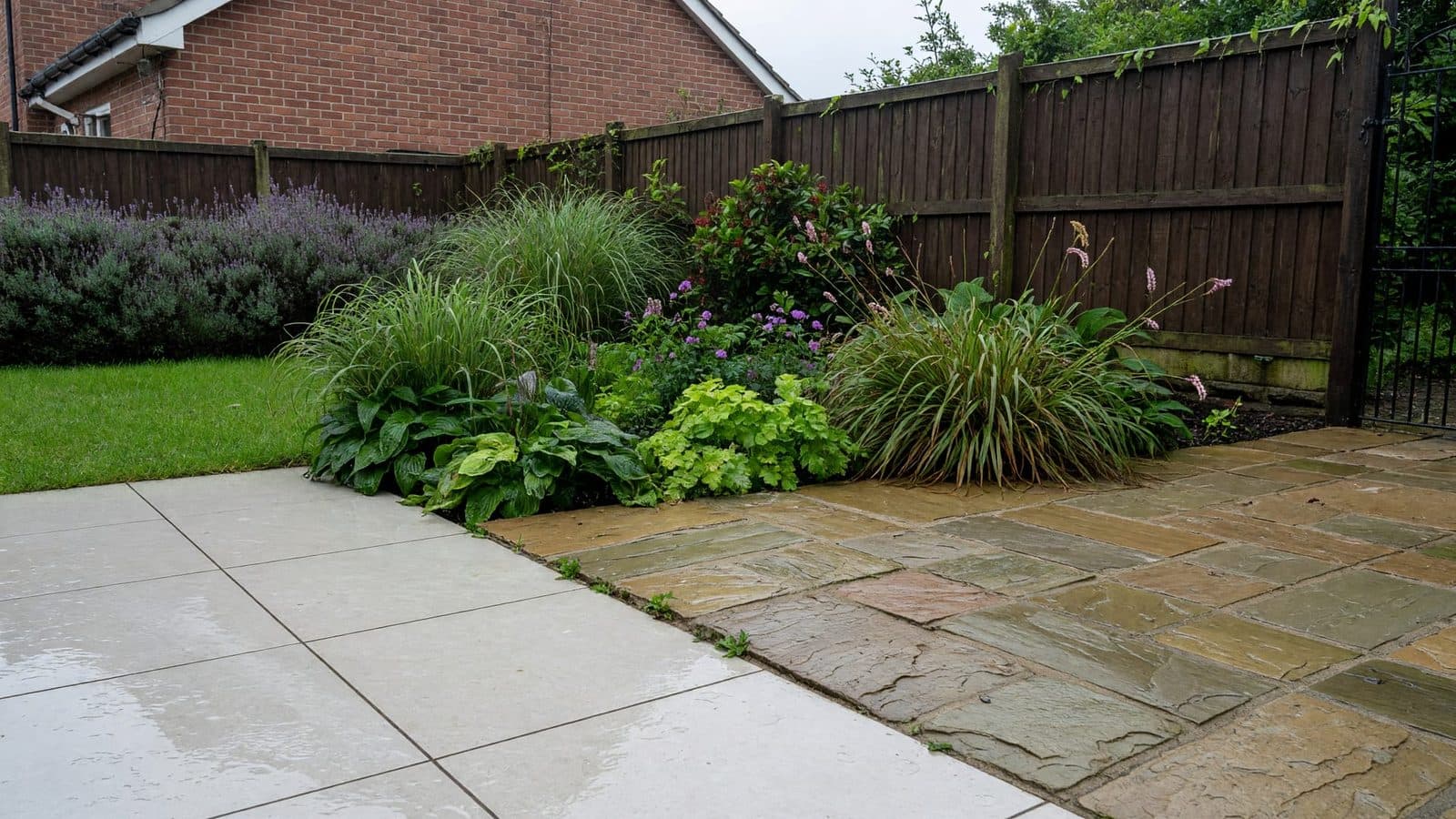
Choose a mix when the brief is both: a porcelain sitting pad off the bifolds and a sandstone path or step that ties into an existing wall. Mixed schemes only work if the levels and joints are designed as one job.
If you are still weighing paving against gravel or a smaller hardstanding, start with how the space will be used — dining, play, bins, a path to the gate — then pick the surface. Patio and paving is the service page; full garden landscaping is the route when the patio is one piece of a rebuild.
Frequently asked questions
Is porcelain too slippery for a wet Preston garden?
Outdoor porcelain with a textured face is specified for wet use. Many ranges are R11. Indoor polished tiles are the product that becomes a rink. Algae film on a patio that does not drain will make any surface slick; that is a falls problem, not a reason to avoid porcelain.
Does sandstone crack in Lancashire frost?
Sound, calibrated Indian sandstone on a drained bed lasts. What flakes is stone that has been left saturated — usually because water is trapped in the joints and the Type 1 tray underneath. Sealing the face helps. Fixing the outlet matters more.
Can you match the porcelain the house-builder left?
Often closely, not always exactly. Send a photo with the enquiry. Batch codes change, and flags that have sat outside for a year have already shifted. If the existing pad is the wrong level or already ponding, we will recommend lifting it.
Which is lower maintenance?
Porcelain, if the joints and falls are right. Sandstone asks for sealing and more washing, particularly in shade. Neither is maintenance-free if the base is a wet hole in clay.
Do I need drainage as well as new flags?
If water still stands 24 hours after rain, or the lawn next to the old patio is a bog, yes. A new surface without an outlet repeats the same puddle in a nicer colour. We design the drain with the patio so you are not digging the garden twice.
If you send photos, the town and a rough size, we can give you a free online estimate and say which material — and which base — fits the plot. Message us on WhatsApp or call 01772 213019. We usually reply within 1 working day; check spam for contact@acorn-gardening.co.uk.
Related services
Prefer a professional install in Preston & the North West? Explore the services that match this guide.
Enjoyed this guide?