Gabion vs sleeper wall next to a stream
A garden that backs onto a brook looks settled until you walk the bank after a wet week. The old sleeper face is soft at the waterline, the bottom course has dropped, and the soil behind is washing through the joints. Replacing the same timber in the same wet line does not fix it. It starts the clock again.
Next to standing or flowing water, a gabion wall is usually the better retaining wall. Timber can still work if the sleepers sit above splash and out of the stream bed. The decision is not which material looks nicer in a photo. It is whether the face will sit in water, take scour on the toe, or only hold a dry bank a few metres back.
Why does timber fail next to water, not just on a slope?
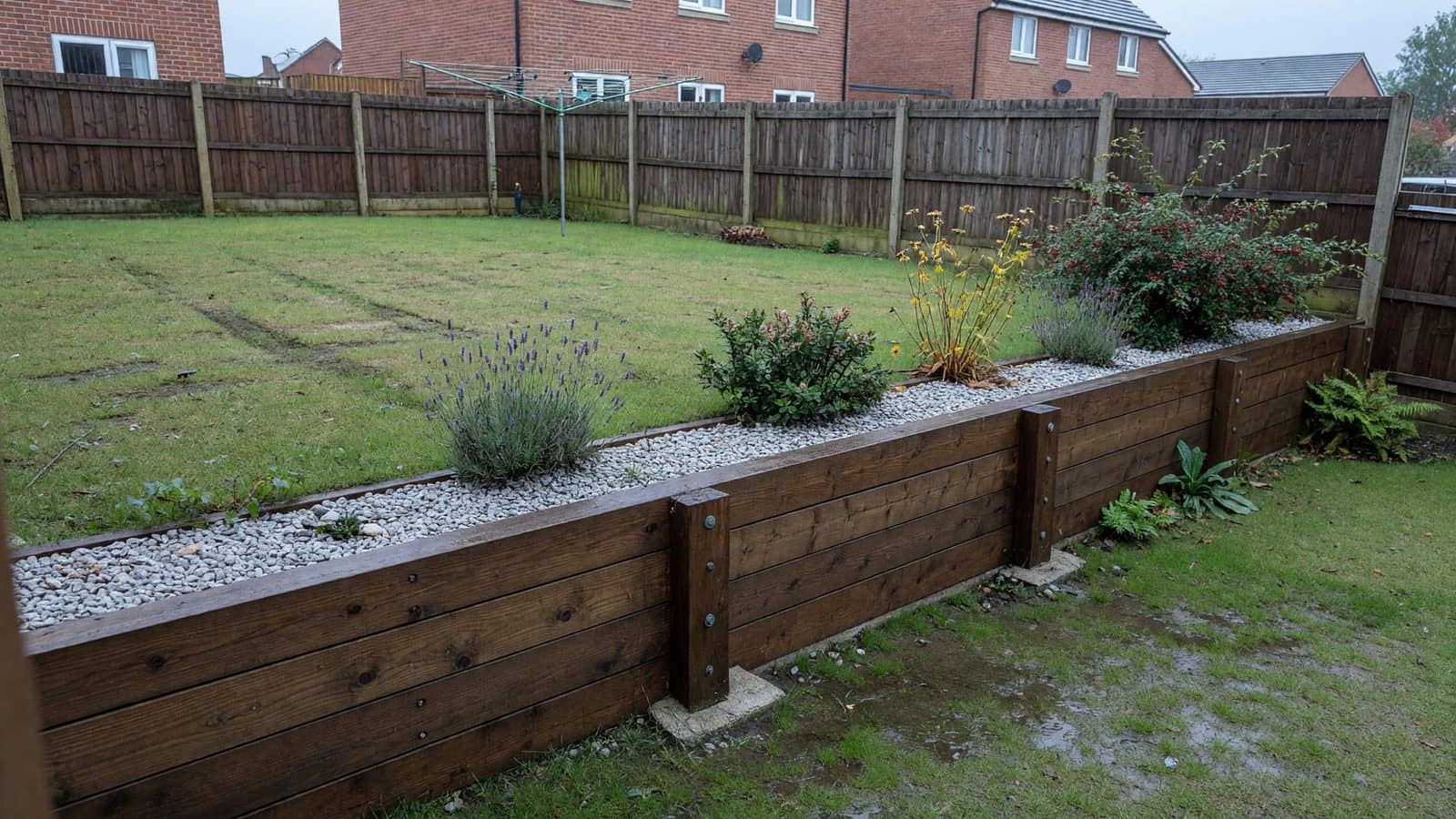
On a dryish Lancashire bank the usual problem is water building up *behind* the wall. That is the job we wrote about in sleeper retaining walls that last on a slope: posts, gravel, a land drain, and a sensible height.
A wall that sits in a stream, a pond overflow or a wet ditch has a different enemy. The timber spends part of the year soaked and part of the year drying. Fungi work fastest in that wet–dry band. The bottom course also takes grit and flow against the face. Softwood treated for ground contact is not treated for a stream bed. Oak lasts longer than cheap treated pine, but the waterline still wins if the sleeper is left sitting in the flow.
Fully buried or fully submerged timber can last surprisingly well because there is little air. The bit that fails is the line you can see: the splash zone, the joints that hold water, and the posts that sit in saturated clay at the toe. Staining the face does not change that.
So if the last wall was timber and it has gone again, putting the same sleepers back in the same place is a rebuild, not a repair.
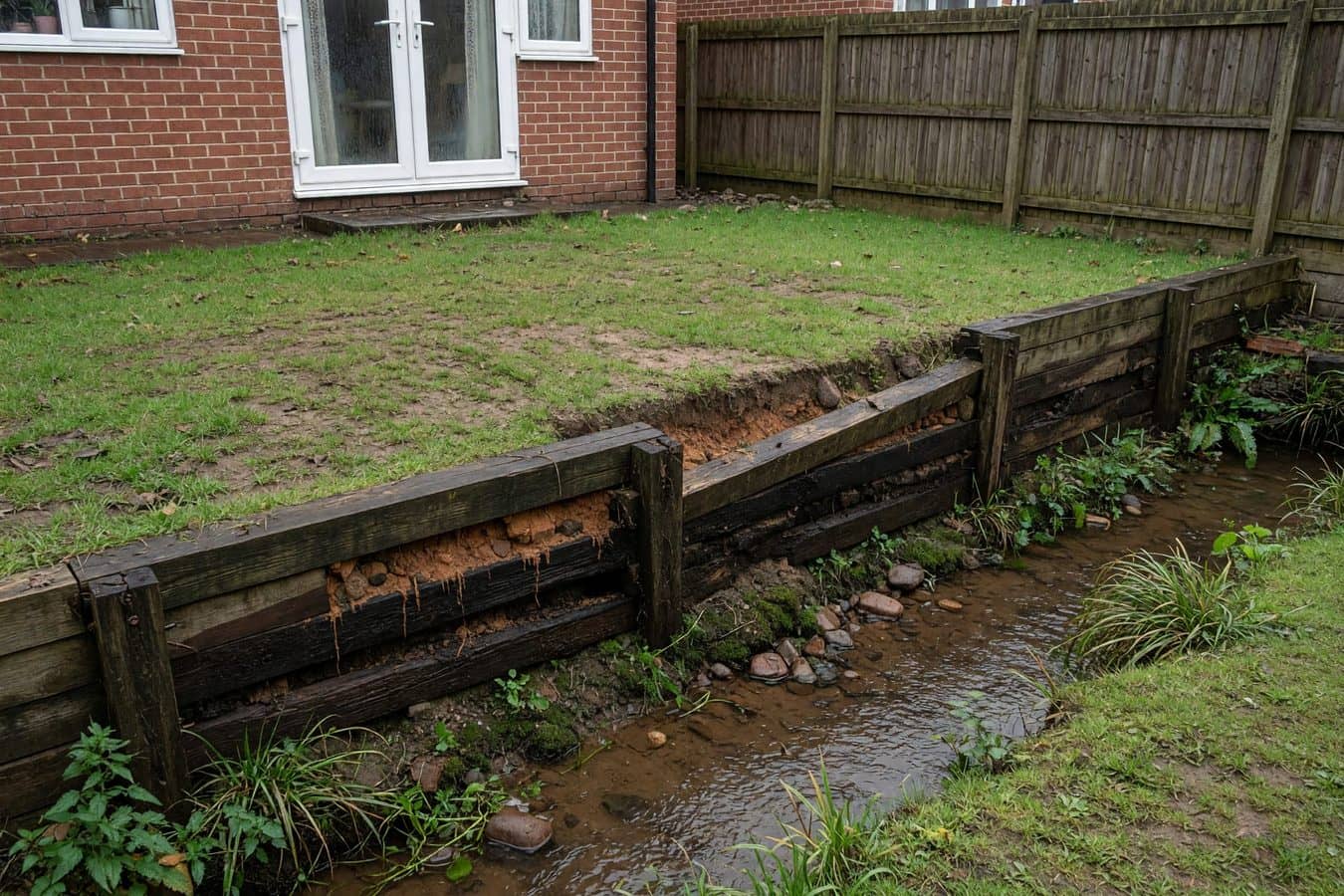
Gabion vs sleeper wall next to a stream
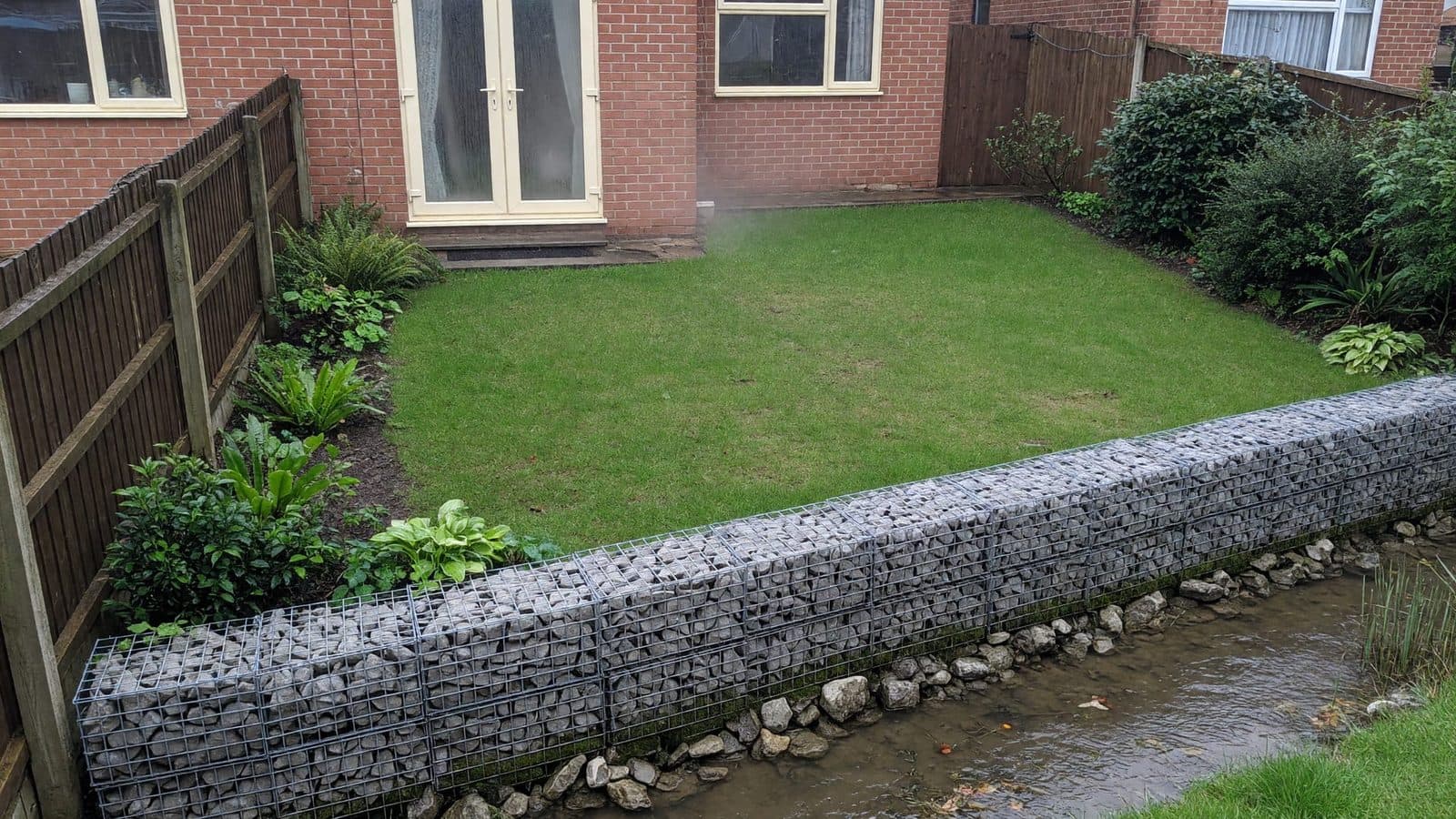
A gabion wall is a stack of wire baskets filled with stone. It holds the bank by mass. Water can pass through the face, so it does not act like a dam. That matters next to a brook, because the ground behind the wall is often wet even in a dry spell.
A sleeper wall holds the bank with posts and the stiffness of the timber. Gaps between sleepers let a little water through, but the posts and the bottom course still sit in the wet. On clay that stays saturated, those posts rot from the ground up.
In plain terms:
- Sleepers — Softer look, quicker on a low dry bank, cheaper on a short run. Poor next to a stream bed, a pond edge or anywhere the toe sits in water for weeks.
- Gabions — Heavier footprint, stone face, almost no trapped water behind the wall. Better where the bank is wet, the brook rises after rain, or you have already replaced timber once.
- Masonry or concrete sleepers — A third option when you want a clean face and a long life, with a proper footing and drainage behind. More construction than a basket wall, and still not a dam unless it is designed as one.
Gabions are not automatically “the engineered answer”. A tall gabion stack still needs a firm base, a geotextile behind the stone so clay does not wash through, and a toe that will not scour out in a flood. A low garden gabion next to a quiet ditch is a different job from training a main river.
When can we still use sleepers near water?
Sleepers are not banned on a wet plot. They fail when they *are* the water’s edge.
We still use timber where:
- the wall is set back from the brook, with planting or rip-rap between the face and the flow
- the retained height is modest — the same working limits as a dry slope, roughly under a metre for timber
- the bottom course sits above normal water and splash, not in the bed
- there is a drained gravel column behind the sleepers and a real outfall, not clay packed against the back
- nothing heavy sits on the crest — no parking, no building, no raised patio pouring onto the face
If the brief is “hold the lawn edge three metres from the water”, timber can be the right wall. If the brief is “stop the bank falling into the brook”, it usually is not.
A membrane on the back of the sleepers helps on a dry bank. Next to a stream it does not make the bottom course waterproof. Keep the timber out of the water first.
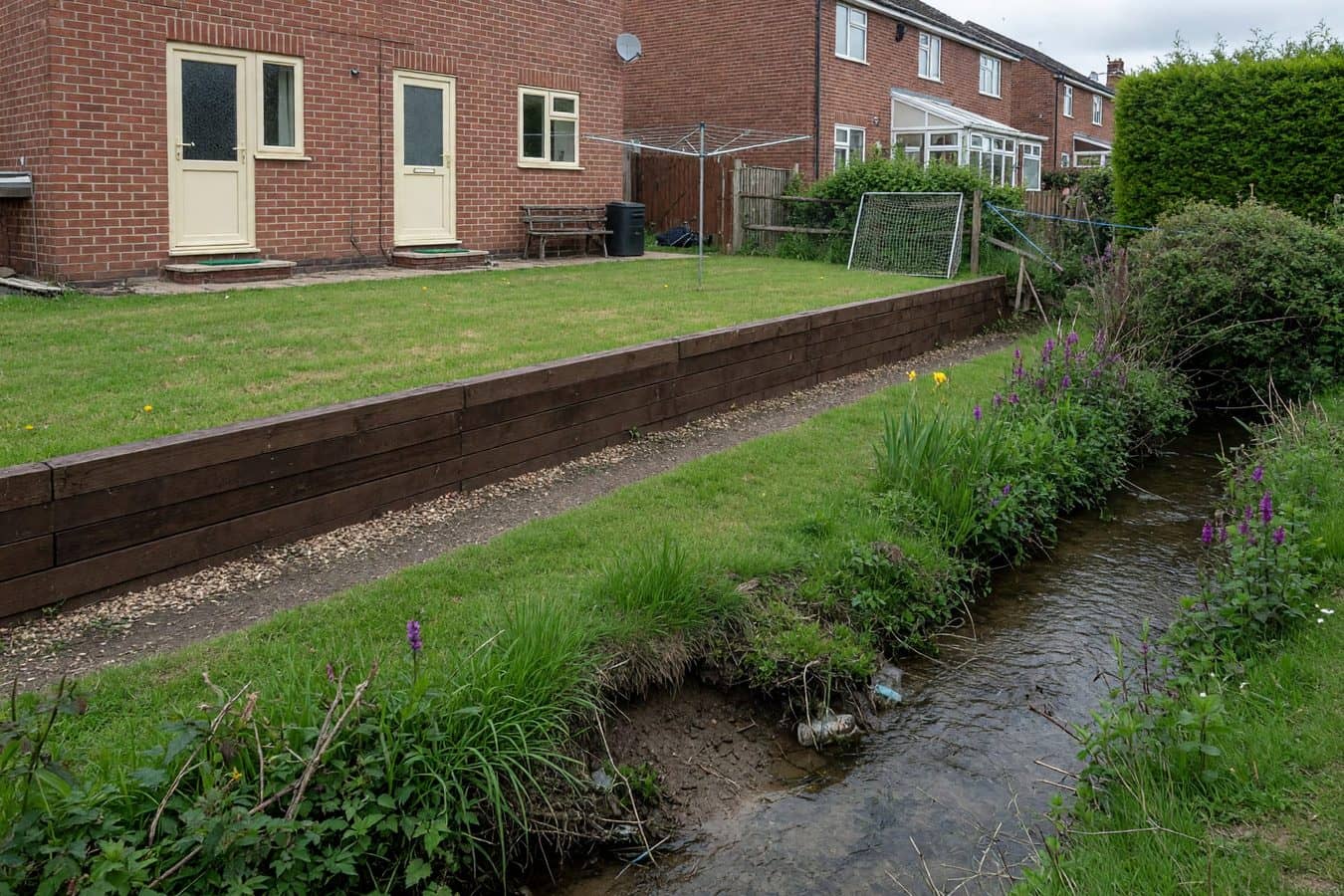
How a gabion wall should sit next to water
The baskets need a level, compacted base. On a brook that means thinking about scour, not just a pretty stone face. If the flow can undercut the bottom basket, the whole stack can settle. On faster water that often means taking the first course below bed level, or sitting the wall on a mattress of stone so the toe cannot wash out.
Behind the baskets we put a non-woven geotextile. Without it, Lancashire clay and silt work through the stone and the wall silts up. The face then looks stained and the mass is no longer free-draining.
The wall should lean back slightly, or step back with height. A vertical stack of baskets on a wet bank is the version that leans first.
Stone fill should be angular and large enough that it cannot fall through the mesh. Rounded pea gravel looks neat in a driveway; it is the wrong fill for a retaining gabion.
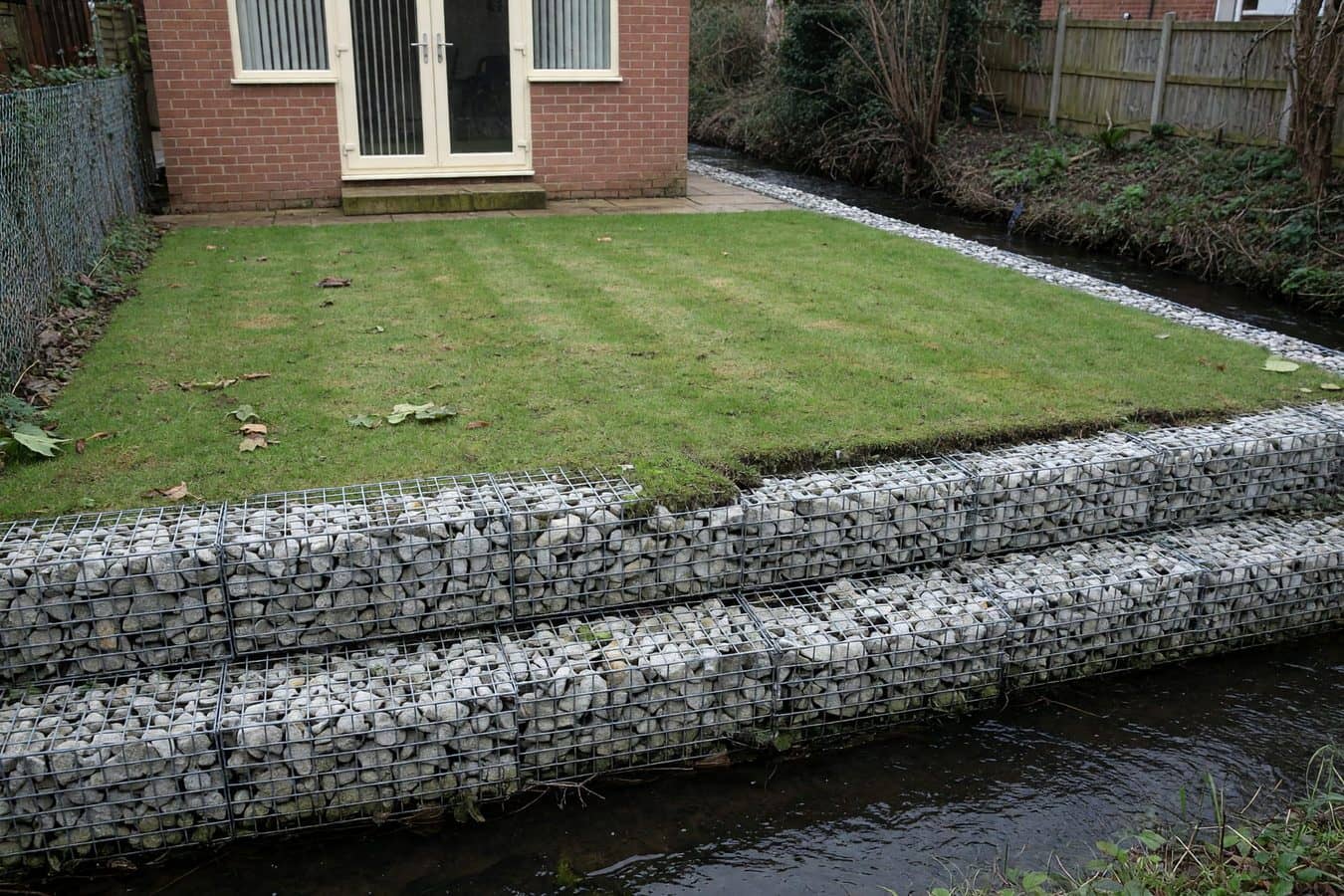
None of that needs to look industrial. A low gabion terrace with planting in the face and a sleeper or paving landing above is a common garden finish. The stone does the wet work. The timber, if you still want it, stays dry.
Consent before you rebuild the bank
This is the part a slope article can skip. Work in or next to a watercourse is not only a landscaping decision.
Most garden brooks and ditches in Preston, Leyland and the villages are ordinary watercourses. Lancashire County Council, as the lead local flood authority, consents certain works under the Land Drainage Act 1991. That can include structures that obstruct or alter flow, culverts, and some bank works. Consent is not granted after you have already built. Planning permission, if you need it, does not replace that consent.
If the watercourse is a main river, the Environment Agency deals with flood-risk activity permits. Work in, over or near the channel, or within eight metres of a flood defence, can need their say-so.
You also have riparian duties if the brook forms your boundary: do not obstruct flow, do not dump arisings in the channel, and do not build something that pushes flood water onto a neighbour.
We do not treat that as paperwork to ignore. On a site visit we look at whether the wall sits in the channel, whether the toe will change the bed, and whether the job is a garden terrace set back from the water or a bank reconstruction. The first is often a landscaping job. The second may need consent before anyone digs.
Check the classification on the Environment Agency’s main-river map, then talk to Lancashire County Council about ordinary watercourse consent if the works will touch the channel. We can help you see which side of that line the design sits on before you spend money on materials.
What we look at on a wet bank
Photos after rain tell us more than a dry summer shot.
We want to see where the water sits against the existing face, how far the bank has moved, what is above the wall, and whether the brook is a quiet ditch or something that rises quickly. Access matters. Baskets and stone are heavy. A narrow side return with no machine access changes the method.
If the wall is only holding a planting bed away from the water, we may still specify sleepers or a mixed face. If the last timber wall has already failed in the wet line, we will say so rather than price the same detail again.
For a full redesign of the levels behind the bank, the same thinking as a terraced sloped lawn still applies: several lower walls beat one tall face. Next to water, the lowest face is the one that has to live with the brook.
Drainage behind the wall still matters, even with gabions. A French drain on the wet side of a lawn can keep the crest from turning to slurry. Gabions pass water; they do not magic away a waterlogged garden above them.
Frequently asked questions
Will oak sleepers last next to a stream?
Longer than treated softwood, not forever in the splash zone. Oak still decays at the wet–dry line. If the bottom course sits in the brook, expect to replace it again. Use oak on a set-back wall, not as the stream bed.
Do gabion walls need drainage behind them?
They are already permeable, so they do not trap water the way a block wall can. They still need geotextile so clay does not wash through, a stable base, and somewhere for water on the garden side to go. A blocked, silted gabion is just a heavy wet bank.
Can I put sleepers on top of gabions?
Yes, as a dry facing or a seat wall above the wet work. Keep the timber out of the water. Bolting a sleeper cap onto a gabion is a finish, not a substitute for mass at the toe.
Do I need planning permission for a garden wall by a brook?
Garden walls often fall under permitted development if they stay under two metres (one metre next to a highway used by vehicles) and the plot has not lost those rights. That is separate from watercourse consent. A wall that changes the channel or ground levels can need both. Check rather than assume.
Can you rebuild a wall that has already been built without consent?
Possibly as a garden structure set back from the water. We will not rebuild an unconsented obstruction in the channel and hope nobody notices. If the existing wall is already in the brook, the first question is what the council will allow, not which stone to order.
Next step
Send a few photos of the bank after rain, a shot along the water, and a note of how high the wall needs to be. A free online estimate is usually back within one to two working days. WhatsApp 01772 213019 is fine for the pictures.
If the job is a good fit we measure on site — levels, the wet line, access and whether consent sits with the county council or the Environment Agency — before we lock a specification. A 25% deposit books the work. We would rather specify the wall that will still be there in fifteen years than sell you another set of sleepers for the stream bed.
Related services
Prefer a professional install in Preston & the North West? Explore the services that match this guide.
Enjoyed this guide?