Slatted Fencing Ideas That Work in Lancashire Weather
Slatted fencing has become the default “modern” boundary for many Preston and Lancashire gardens—and for good reason. Horizontal (or carefully spaced vertical) boards give privacy without the fortress feel of solid closeboard, and they pair cleanly with composite decking and porcelain paving. The catch is weather: wind load, driving rain and clay soils punish weak posts and poor detailing. This guide covers design ideas that work here, and how professional fencing keeps them standing.
If you want a pure build sequence, our existing slatted fence how-to covers DIY steps. Here the focus is design choices and durability for North West conditions.
Why slatted fences suit local gardens
- Privacy with light — gaps reduce the tunnel effect of solid panels
- Contemporary lines — horizontal battens can make narrow plots feel wider
- Flexible height and density — tighter spacing for privacy; more open for a decorative screen
- Pairs with outdoor rooms — decks, patios and planting read as one design language
On new-build estates where standard 1.8 m panels leave upstairs overlooking, slatted runs are often combined with taller planting or structured screens rather than illegal boundary height hacks.
Design ideas that work in practice
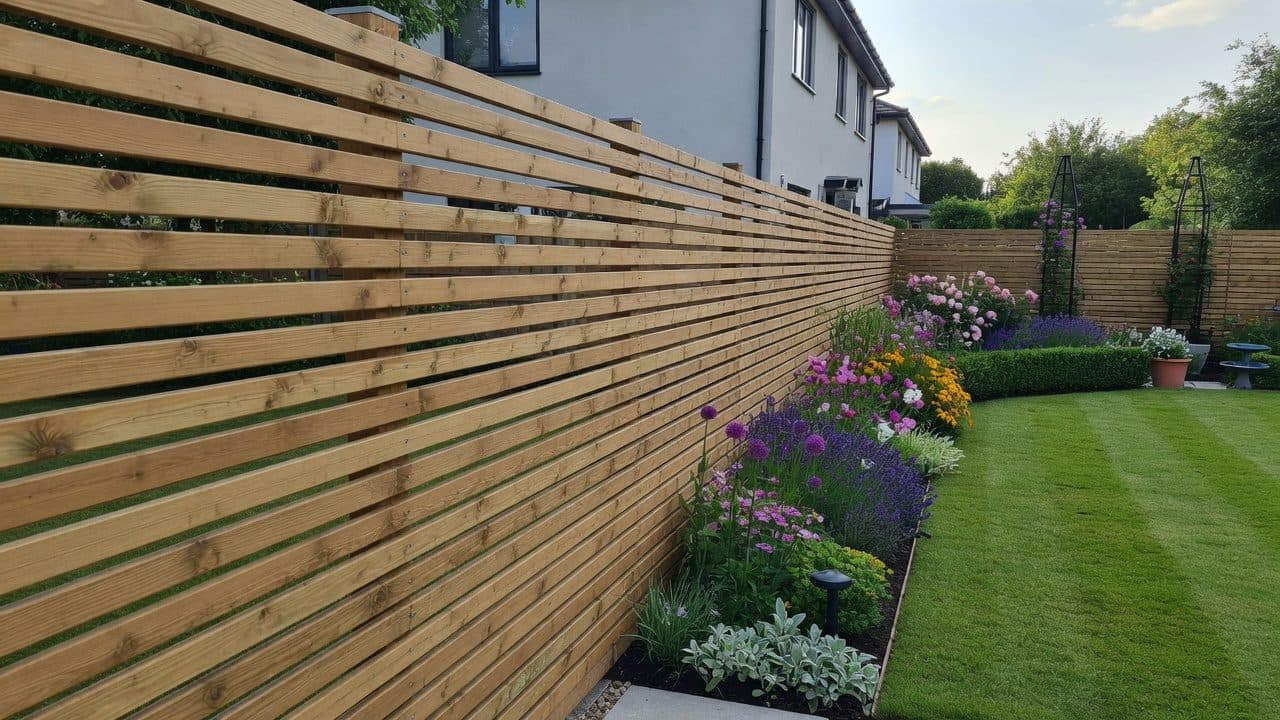
1. Full-boundary horizontal slats
A continuous horizontal run along one or more sides gives a clean architectural edge. Keep post spacing honest (commonly in the 1.8–2.4 m region depending on design) and use quality rails so the face does not wave after the first wet winter.
2. Mixed solid + slatted zones
Use closeboard or solid panels where you need maximum privacy (bins, side alley, opposite a bedroom window) and slatted sections where you want light and a softer look. Mixed designs need a clear horizontal datum so the garden does not look accidental.
3. Slatted privacy screens (not full boundaries)
Freestanding or post-set screens beside a patio or deck create outdoor rooms without fencing the entire plot. Popular with composite deck lounges and pergola dining zones.
4. Hit-and-miss / dual-aspect slats
Boards staggered on alternate faces give privacy from both sides while still moving some air. Useful on exposed plots where solid fences act like sails.
5. Softened with planting
Slats behind ornamental grasses, climbers on discreet wires, or a low hedge in front of the fence reduce the “timber wall” effect and improve biodiversity. Plan root space so planting does not lift posts.
6. Gates that match
A mismatched gate ruins a premium run. Specify gate furniture, clearances and drop bolts at design stage—especially on sloping Lancashire paths where gates bind if posts move.
Lancashire weather: what to design for
- Wind — Adequate post depth and diameter; not oversized panel spans
- Rain & wet clay — Posts set properly; gravel/concrete details that shed water; no rotting posts in standing water
- Movement — Quality fixings; allowance for timber movement; straight lines checked with string
- Algae & greying — Accept natural silvering or plan a maintenance stain cycle
- Boundary rules — Respect height limits and neighbour agreements
Cheap concrete gravel boards help in some designs; in others a clear gravel gap and good posts matter more than decorative extras.
Materials and finishes
- Pressure-treated softwood — common, cost-effective; check treatment class and expected life
- Cedar / larch and similar — premium look; different cost and weathering character
- Composite slat systems — low maintenance; must be installed as a system with correct posts
- Metal posts with timber faces — strong primary structure where specified
Colour: dark stains hide algae better for some owners; natural finishes weather to silver. Match house windows and cladding where possible.
Install considerations (hire vs DIY)
Professional install focuses on:
1. Straight set-out along the true boundary 2. Posts plumb and at correct centres 3. Consistent slat gaps (typically in a modern 10–20 mm design band, adjusted for privacy goals) 4. Secure rails and pre-drilled fixings to reduce splitting 5. Neat junctions to walls, houses and existing fences 6. Tidy site and safe working near neighbours
DIY can work for a short decorative screen on perfect ground. Full rear boundaries on clay, slopes or shared lines are where contractor work usually wins on longevity and neighbour relations.
How slatted fencing fits a wider garden project
Fencing is often phase one of a larger scheme: once privacy and dogs are sorted, patio, decking or full landscaping follows. We can quote fencing alone or as part of a package so levels and gate positions match future hard landscaping.
Privacy, light and neighbour sightlines
Slatted fences live in a sweet spot between solid closeboard and open rail. On Preston and Leyland estates the practical questions are:
- Seating height privacy — can someone sitting on your patio see into the neighbour’s kitchen, and vice versa?
- First-floor overlooking — boundary height alone rarely fixes bedroom windows; planting or pergola structure may need to share the job.
- Light to small gardens — tighter slat gaps improve privacy but darken narrow side returns; open gaps keep mossy alleys slightly healthier.
- Dog and ball security — very open decorative screens are not the same as a secure boundary for pets.
A useful design move is to tighten spacing on the privacy-critical elevation and open it slightly where the fence only frames planting. Keep a consistent board thickness and horizontal alignment so mixed density still reads as one design language.
Detail checklist that keeps slats looking intentional
1. Post tops and cappings finished to a single height datum where the ground allows 2. Equal gaps checked with spacers—not “by eye” after lunch 3. Bottom clearance or gravel board strategy so boards are not sitting in wet soil 4. Corners and wall junctions planned rather than butted with random offcuts 5. Gate furniture that matches the weight of the leaf (heavy leaves need proper hinges and stops) 6. Face direction agreed with neighbours where both sides are visible
These are the details that separate a Pinterest-style fence from a wavy DIY run after the first wet Lancashire winter.
Wind and exposure on North West plots
Exposed rear gardens, hillside streets and long rear runs behave like sails when clad in solid timber. Slatted and hit-and-miss designs reduce some wind load compared with fully closed panels, but they do not allow undersized posts. Design still needs:
- Adequate post section for height
- Proper hole depth and concrete in clay
- Sensible bay widths
- Recognition that corner posts and gate posts work harder
If a previous fence failed by leaning after storms, replacing like-for-like panels on the same shallow posts will fail again—regardless of how modern the slats look in the brochure.
Maintenance expectations (honest)
- Softwood will weather; plan either to embrace silvering or to restain on a cycle that matches exposure.
- Algae on north-facing runs is normal in damp climates; periodic cleaning keeps the design crisp.
- Fixings should be corrosion-resistant; cheap screws telegraph rust streaks.
- Climbers are lovely—choose supports that do not lever boards off rails, and leave inspection access for posts.
Style pairings that work locally
- Composite deck lounge — Horizontal dark or natural slats — Same contemporary language as modern boards
- Porcelain patio dining — Mixed solid + slatted zones — Privacy where seated; light toward planting
- Play lawn with pets — Secure height + tighter lower gaps — Containment without full fortress walls
- Front side return — Lower decorative screen or hit-and-miss — Security and airflow; less tunnel effect
Next step
If you want slatted fencing that still looks straight after a Lancashire winter, request a free online estimate for fencing. Share approximate run length, height, photos of the boundary and any gate needs—we cover Preston, Leyland and the wider North West.
Related reading: fence company versus DIY, and what a proper fencing quote should include.
Related services
Prefer a professional install in Preston & the North West? Explore the services that match this guide.
Enjoyed this guide?